

Qi, Prana, Life Force: Why So Many Cultures Developed a Language for Vital Energy
Qi, prana, ki, vital force—cultures around the world developed language for the animating quality of life. Explore what these traditions actually mean, where they overlap, and why they should not be reduced to modern scientific terms too quickly.
Across cultures that developed thousands of miles apart, people created language for something they experienced as vital, animating, and deeply connected with health and life.
In China, that language includes qi.
In India, prana.
In Japan, ki.
Other traditions have used terms such as vital force, breath of life, spirit, or life energy.
The words are not identical, and the traditions behind them should not be collapsed into one idea.
But the recurrence of these concepts across cultures raises a fascinating question:
Why did so many human traditions come to describe life as more than matter alone?
QI: MORE THAN A SIMPLE TRANSLATION
In Chinese philosophy and medicine, qi is a foundational concept.
It is often translated into English as “energy” or “life force,” but those translations can oversimplify the original meaning.
Qi has been used historically in ways that include breath, vitality, movement, transformation, material process, and the dynamic activity through which life and the natural world are organized.
That is worth remembering.
When we use the word energy in English, we may think immediately of electricity or physics.
Traditional qi language belongs to a different intellectual framework.
PRANA: BREATH, VITALITY, AND LIFE
Prana comes from Indian philosophical and yogic traditions.
It is often translated as vital energy, life force, or breath.
In yoga, prana is closely connected with breathing, but it is not limited to oxygen or the mechanical act of respiration.
Traditional yogic teachings describe prana as a subtle life-sustaining principle that moves through the body and is influenced by breath, attention, posture, and practice.
Pranayama—the yogic discipline of working with breath—is named from the same root.
That research does not prove prana as a measurable physical substance.
It does show that the experience and language of prana remain meaningful enough to study systematically.
KI: THE JAPANESE LANGUAGE OF VITAL ENERGY
The “ki” in Reiki is related linguistically and culturally to the Chinese concept of qi.
Japanese culture uses the character in many words connected with mood, vitality, atmosphere, spirit, and condition.
In Reiki, ki is commonly explained as life energy or vital energy.
That is one reason Reiki is often translated as “universal life energy.”
Again, translation gives us a useful doorway, but not a perfect equivalence.
The concept carries cultural meaning that is difficult to fit neatly into one English word.
WHY BREATH APPEARS SO OFTEN
One of the most interesting patterns across traditions is the connection between life energy and breath.
That makes intuitive sense.
Breathing is one of the clearest signs of life.
Breath changes with emotion.
Breath changes with exertion.
Breath changes with fear, rest, sleep, grief, prayer, meditation, and pain.
And unlike most physiological processes, breathing sits in a unique place between voluntary and automatic control.
We breathe without thinking about it, but we can also intentionally change how we breathe.
Ancient traditions may not have used modern language about autonomic regulation, carbon dioxide, vagal signaling, or respiratory chemistry.
But they had direct access to the experience of breath and its effects on state.
That alone may help explain why breath became one of humanity’s oldest bridges between body and spirit.
ARE QI, PRANA, AND BIOELECTRICITY THE SAME THING?
No one can responsibly say that they are.
Bioelectricity refers to measurable electrical properties of living cells and tissues.
Qi and prana come from traditional philosophical and healing systems with much broader meanings.
It is tempting to translate ancient concepts directly into modern physiology, but doing so can flatten both sides.
The fact that cells have membrane potentials does not prove qi.
The fact that the heart generates an electromagnetic field does not prove prana.
The fact that Reiki uses the word ki does not mean Reiki energy has been identified as a known electromagnetic phenomenon.
Those distinctions matter.
But distinction does not mean the traditions have nothing to say to one another.
A QUESTION OF LANGUAGE
Imagine two people standing beside the same river.
One describes water temperature, flow rate, mineral content, and pressure.
The other describes the river as cleansing, powerful, sacred, alive, or emotionally meaningful.
Are they talking about the same river?
Yes.
Are they saying the same thing?
No.
One language does not automatically replace the other.
Traditional energy systems and modern physiology may sometimes work like that.
Science asks for measurable mechanisms.
Traditional systems often describe patterns of lived experience, balance, relationship, movement, and meaning.
Some concepts may eventually overlap with measurable biology.
Others may remain symbolic, experiential, philosophical, or spiritual.
We do not have to force every word into a laboratory category in order to learn from it.
WHY SO MANY CULTURES NOTICED “VITALITY”
Human beings have always been able to observe the difference between a living body and a dead one.
The structure may still be present, but something unmistakable has changed.
Breath stops.
Warmth changes.
Movement ceases.
Responsiveness disappears.
Presence feels different.
Long before physiology could describe ATP, ion gradients, metabolism, neural firing, circulation, or oxygen exchange, people needed language for the quality that seemed to animate life.
It is not surprising that cultures created concepts of vitality.
What is remarkable is how persistent those concepts have been.
Western history has its own versions: vitalism, vital force, animal magnetism, and other theories attempted to explain what made living systems different from nonliving matter.
Many of those historical theories were later replaced or revised as biology developed.
But the deeper question—what makes a living system organized, responsive, self-repairing, and conscious—has not disappeared.
SCIENCE HAS EXPLAINED MUCH, BUT NOT EVERYTHING
Modern biology has explained an extraordinary amount about how life functions.
We know about cellular respiration, genetics, metabolism, electrophysiology, signaling pathways, immune responses, and development.
We can measure many processes ancient healers could only observe indirectly.
But explaining mechanisms does not necessarily exhaust the human experience of being alive.
Consciousness remains mysterious.
The way meaning changes physiology is still being studied.
The body’s ability to organize itself across billions of cells continues to reveal new layers of complexity.
So I do not see ancient energy concepts as competitors to science.
I see them as part of humanity’s long attempt to describe life.
Some of those descriptions may eventually map onto measurable physiology.
Some may not.
Some may have value precisely because they describe experience rather than mechanism.
THE VALUE OF NOT RUSHING THE TRANSLATION
There is a temptation in wellness spaces to say, “Qi is electricity,” or “prana is the biofield,” or “ancient people already knew quantum physics.”
I do not think we need those claims.
They make the conversation smaller, not bigger.
Ancient traditions deserve to be understood on their own terms.
Science deserves to be represented accurately.
And mystery deserves to remain mystery when we do not yet know.
The more interesting question is not, “Which ancient word is secretly the modern scientific term?”
The more interesting question is:
What were people noticing that led them, again and again, to describe life as movement, breath, vitality, flow, and connection?
That question can stay open.
And I think there is wisdom in leaving it open long enough to really listen.
SOURCES FOR CURIOUS READERS
Kim M. Understanding Qi: Its Development and Clinical Application to Nursing Practices. 2008.
DNA, Energy, and Information: Beyond the Double Helix
DNA is not a mystical blueprint that determines everything about us. Explore gene regulation, epigenetics, cellular energy, and emerging research on ultraweak photon emission without turning science into mythology.
DNA may be one of the most misunderstood symbols in wellness culture.
We often hear phrases like “your genes are your destiny” on one side and “you can change your DNA with your thoughts” on the other.
Biology is much more interesting than either extreme.
DNA stores information—but genes are regulated
Your DNA sequence contains genetic information, but cells constantly regulate which genes are active, when they are active, and how strongly they are expressed.
Epigenetics is one part of that regulation. Chemical modifications to DNA and associated proteins, along with noncoding RNAs and other mechanisms, can influence gene expression without changing the underlying DNA sequence.
A 2026 review of environmental epigenetics describes epigenetic processes as an important interface between genetic predisposition and lifelong environmental influences. A 2025 review of stress and epigenetic regulation discusses ways stress can influence DNA methylation, histone modifications, and noncoding RNA.
This does not mean thoughts simply rewrite your genetic code
Environment and experience can influence biology, but that is not the same as saying every belief directly edits DNA on command.
Epigenetics is complex, tissue-specific, and shaped by many interacting factors. I still find the larger message powerful: genes are important, but biology is dynamic.
Where does “energy” enter the conversation?
Cells require energy to maintain gradients, build molecules, repair damage, communicate, and stay alive. Living systems are chemical and electrical at the same time.
There is also emerging work on ultraweak photon emission—extremely faint light produced by biological processes. A 2024 review summarizes research on these emissions and their relationship to cellular metabolism and oxidative processes.
A provocative 2024 study reported ultraweak photon emission from isolated DNA under specific experimental conditions. It is an intriguing finding, not proof that DNA is a spiritual antenna or that thoughts communicate with genes through light.
Information is one of biology’s biggest themes
DNA stores sequence information. Cells communicate through molecules, voltage, mechanical forces, and timing. Tissues coordinate across distances. Organisms continually sense and respond to their environments.
That language—signal, message, pattern, memory, regulation—can sound surprisingly close to the language used in energy work. But similarity in language is not proof that the mechanisms are the same.
The more we learn, the more interesting life becomes
I do not need to exaggerate science to find it extraordinary.
DNA is not a static fate. Cells are not passive containers. The body is continuously exchanging energy and information at many levels.
And there is still an enormous amount we do not understand about how all of those levels become one coherent living person.
Sources for curious readers
Environmental Epigenetics: New Horizons in Redefining Biological and Health Outcomes
Epigenetic Regulation of Stress
Reiki Is Not a Religion: What It Is, What It Asks of You, and What It Does Not
Reiki is spiritual, but it is not a religion. It does not require conversion, worship, or belief in a particular deity. Learn what Reiki actually asks of the person receiving it—and what it does not.
One of the questions people quietly carry into energy work is not really about Reiki technique at all.
It is about faith.
Is Reiki a religion? Does receiving Reiki mean participating in someone else’s spiritual beliefs? Do you have to believe in chakras, spirit guides, reincarnation, Buddhism, or anything else in order for a session to make sense?
For people with strong religious backgrounds, those questions can matter deeply.
So I want to answer them clearly.
Reiki is not a religion.
It has spiritual roots and can be practiced in a deeply spiritual way, but it does not require worship, doctrine, conversion, membership, or belief in a particular deity.
WHAT REIKI ACTUALLY IS
Reiki is a Japanese system of spiritual practice and hands-on or hands-near healing that developed through Mikao Usui in the early twentieth century.
In a typical session, the practitioner places hands lightly on or just above the body and allows Reiki to flow with the intention of supporting balance, relaxation, and the recipient’s natural healing response.
That definition does not involve religious conversion or doctrine because neither is required for the practice.
Traditional Reiki teachings include meditation, self-practice, ethical precepts, and spiritual development. Those elements can feel spiritual because they are.
Spiritual, however, does not automatically mean religious.
SPIRITUALITY AND RELIGION ARE NOT THE SAME THING
Religion generally involves an organized system of beliefs, teachings, rituals, community, and often a particular understanding of God or the sacred.
Spirituality can be much broader.
A person may experience spirituality through prayer, nature, meditation, art, service, intuition, silence, religious worship, or a felt relationship with something larger than themselves.
Reiki can sit within that wider spiritual space without asking a person to leave their own faith behind.
A Christian can receive Reiki.
A Buddhist can receive Reiki.
A Muslim, Hindu, Jewish, agnostic, atheist, or spiritually curious person can receive Reiki.
Receiving Reiki does not require adopting the practitioner’s worldview.
WHAT REIKI ASKS OF THE PERSON RECEIVING IT
Very little.
You do not have to understand Reiki.
You do not have to “believe hard enough.”
You do not have to visualize correctly.
You do not have to pray to anyone.
You do not have to accept a new theology.
You can simply rest and receive the session.
That simplicity is one of the things I appreciate most about Reiki.
The recipient does not need to perform spirituality for the practitioner.
WHAT ABOUT THE REIKI PRECEPTS?
Mikao Usui’s system included a set of ethical or contemplative principles commonly known as the Reiki precepts.
Translations vary, but they generally encourage practitioners not to be consumed by anger or worry, to practice gratitude, work honestly, and be kind to others.
Those are spiritual principles, but they are not a creed.
They do not tell a person which God to worship.
They do not tell a person what happens after death.
They do not require rejection of another religion.
They function more like a daily practice of character and awareness.
REIKI DOES NOT REQUIRE CALLING IN SPIRITS OR BEINGS
This is an important distinction because modern energy-healing communities are diverse.
Some practitioners incorporate angels, guides, ancestors, crystals, oracle cards, chakra systems, prayer, or other spiritual practices into their work.
Those practices may be meaningful to them.
But they are not required in order for something to be Reiki.
A Reiki session can be very simple: practitioner, recipient, intention, hands, quiet, and Reiki.
That matters because sometimes people encounter one practitioner’s personal spiritual style and assume that everything surrounding the session is part of Reiki itself.
It is not necessarily so.
A practitioner’s additions are not the same thing as the core practice.
CAN REIKI FIT WITH CHRISTIANITY OR ANOTHER FAITH?
Different religious communities answer that question differently, and I would never tell someone what their faith must permit.
That is a conversation a person may want to have with their own clergy, spiritual adviser, or conscience.
What I can say is that Reiki itself does not require a person to worship another deity, renounce their religion, or accept a competing religious doctrine.
Many people understand Reiki as a form of compassionate, prayerful, or spiritually grounded care that fits comfortably alongside their existing beliefs.
Others prefer not to participate in any energy-healing practice for theological reasons.
Both choices deserve respect.
I do not think anyone should be pressured spiritually in order to receive care.
WHAT REIKI DOES NOT ASK ME TO DO AS A PRACTITIONER
Reiki does not ask me to diagnose disease.
It does not ask me to replace someone’s physician, therapist, medication, church, or spiritual community.
It does not require me to tell a client what they should believe.
It does not give me authority over another person’s spiritual life.
My role is to create a grounded, compassionate space and practice Reiki within the scope of what I actually offer.
That boundary is important to me.
A person should be able to receive support without feeling that their beliefs are being recruited, corrected, or judged.
WHY REIKI CAN FEEL SPIRITUAL EVEN WITHOUT RELIGION
Reiki sessions are often quiet.
People slow down.
They notice their breathing.
They notice sensations in the body.
They may feel warmth, tingling, emotion, stillness, peace, or a sense of connection.
Those experiences can feel spiritual because deep stillness itself can feel spiritual.
We do not always need to turn that experience into a doctrine.
Sometimes a moment of peace is simply a moment of peace.
Sometimes it feels like prayer.
Sometimes it feels like energy.
Sometimes it feels like the nervous system finally softening.
Sometimes the person has no words for it at all.
I am comfortable leaving room for that mystery.
WHAT SCIENCE SAYS—AND DOES NOT SAY
Reiki is also studied as a complementary health practice.
That scientific uncertainty does not turn Reiki into a religion.
It simply means that the mechanism and clinical effects remain questions for research.
Science and religion answer different kinds of questions.
Reiki does not need to be classified as one simply because science has not fully explained the other.
THE SIMPLEST WAY I CAN SAY IT
Reiki is a spiritual healing practice, not a religion.
You can bring your faith with you.
You can bring your questions with you.
You can bring no particular spiritual belief at all.
You do not have to become anything new in order to receive Reiki.
And for me, that openness is part of what makes the practice so beautiful.
SOURCES FOR CURIOUS READERS
National Center for Complementary and Integrative Health. Reiki.
Vitale A. Reiki: Defining a Healing Practice for Nursing. 2020.
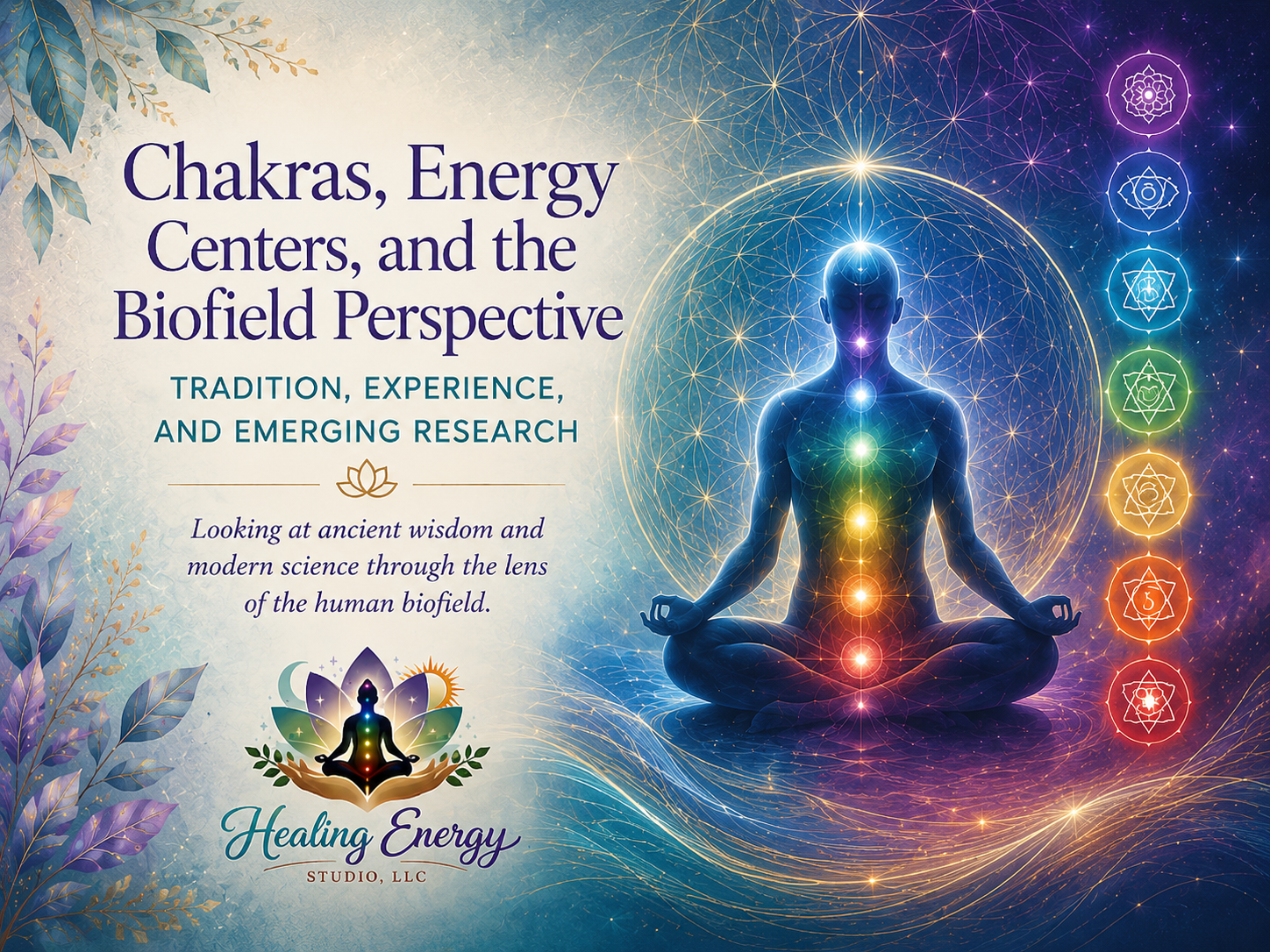
Chakras, Energy Centers, and the Biofield Perspective
Chakras come from ancient Indian spiritual traditions; the biofield is a modern research framework. They are not the same—but exploring both can open an interesting conversation about energy, experience, and the body.
Chakras are one of the most recognizable images in modern energy work: a series of centers running through the body, often shown in rainbow colors from root to crown.
But the history is much richer than that familiar diagram.
Chakras come from spiritual tradition
Chakra systems developed within Indian religious, philosophical, and yogic traditions. Different historical texts describe different numbers, meanings, symbols, and practices. The seven-chakra model common in Western wellness culture is one influential modern presentation—not the only chakra system that has ever existed.
Traditionally, chakras are part of a subtle-body framework rather than anatomical organs.
The biofield is a different concept
The modern term biofield is used in some scientific and integrative-health literature as a proposed framework for studying electromagnetic, biophotonic, and other spatially distributed aspects of living systems. One influential paper, Biofield Physiology, discusses measurable electrical and magnetic fields as well as more exploratory areas of research.
A biofield is not scientifically established as being the same thing as the chakra system. That distinction is important.
Why do people still find chakra language useful?
Because it gives people a map for paying attention.
The heart center can become a way to explore love, grief, boundaries, and connection. The throat can become a way to reflect on expression and truth. The root can become a way to think about safety, belonging, stability, and embodiment.
Whether someone understands those centers literally, symbolically, spiritually, or energetically, the framework can prompt meaningful self-observation.
Experience does not automatically equal anatomy
People may feel warmth, pressure, tingling, emotion, pulsing, openness, or heaviness in places commonly associated with chakras. Those experiences are real experiences.
What causes them may vary. Attention, breathing, muscle tension, autonomic shifts, expectation, emotion, sensory processing, and personal spiritual interpretation may all play roles.
Two maps can coexist without being identical
Modern anatomy gives us one map of the human body. The nervous system gives us another. Traditional energy systems give us another. Psychology gives us another.
None of them needs to erase the others.
I use chakra language as part of a broader energy-healing framework because it can help people notice patterns and connect with their own experience. I also think it is important to respect where those ideas came from and to avoid claiming that modern science has confirmed more than it actually has.
Sources for curious readers
Reiki: Where It Came From and How a Japanese Healing Practice Spread Around the World
Reiki began in Japan in the early twentieth century and traveled through teachers, lineages, and cultures to become a global healing practice. Explore Mikao Usui, the Reiki precepts, how Reiki spread, and what has changed along the way.
Reiki is often described today as an energy-healing practice, but that simple description leaves out a fascinating history.
It began in Japan in the early twentieth century and is most closely associated with Mikao Usui, a Japanese spiritual practitioner and teacher. From there, Reiki traveled through students and lineages, crossed cultures and languages, and eventually became one of the most widely recognized energy-healing practices in the world.
Understanding that history matters because Reiki did not appear out of nowhere, and it was not created as a modern wellness trend.
It developed in a particular cultural and spiritual context.
WHO WAS MIKAO USUI?
Mikao Usui was born in Japan in 1865 and is generally recognized as the founder of the system that later became known internationally as Reiki.
Historical accounts differ on some details of his life, and Reiki traditions have sometimes passed stories orally that are difficult to verify. What is consistent across modern historical reviews is that Usui developed a system of spiritual practice and healing in Japan in the early 1920s.
Usui’s system included more than hands-on healing. It also included meditation, personal discipline, ethical principles, spiritual development, and practices intended to cultivate awareness and balance.
That is important because modern Reiki is sometimes reduced to “putting hands over someone.” Historically, it was a broader practice.
THE REIKI PRECEPTS
One of the best-known parts of Usui’s system is a short set of guiding principles often called the Reiki precepts.
Different schools translate them differently, but they commonly center on themes such as not giving oneself over to anger or worry, practicing gratitude, working honestly, and treating others with kindness.
These are not doctrines that require membership in a religion.
They are ethical and contemplative practices.
For many Reiki practitioners, the precepts are as important as the hands-on work because they point to the idea that healing begins with how we live, respond, and relate to the world.
HOW DID REIKI SPREAD?
Usui taught students in Japan. One of the most influential was Chujiro Hayashi, a retired naval officer and physician who developed a more structured clinical approach to Reiki practice and training.
Hayashi later taught Hawayo Takata, a Japanese-American woman born in Hawaii who became enormously important to Reiki’s spread outside Japan.
Takata brought Reiki to Hawaii and the continental United States and trained students who went on to teach others.
This transmission through teachers and students is why Reiki practitioners often speak about lineage.
A Reiki lineage is essentially the chain of teachers connecting a practitioner back through earlier teachers to the practice’s Japanese roots.
Lineage does not mean every modern Reiki school teaches exactly the same way.
Quite the opposite.
As Reiki moved through countries and cultures, different schools developed different language, symbols, teaching structures, spiritual interpretations, and styles of practice.
WHAT DOES THE WORD “REIKI” MEAN?
The Japanese word is usually written with two characters: rei and ki.
In modern Reiki teaching, “rei” is often translated as universal or spiritual, while “ki” refers to vital energy or life energy.
That is why Reiki is commonly translated into English as “universal life energy” or “universal life-force energy.”
Translations are never perfect, especially when spiritual and philosophical concepts cross languages.
The important point is that ki is related to the broader East Asian concept of vital energy—the same family of ideas discussed as qi in Chinese traditions.
REIKI WAS SHAPED BY JAPANESE CULTURE
To understand early Reiki, it helps to remember the Japan in which Usui lived.
Japanese spiritual life included influences from Buddhism, Shinto, meditation traditions, martial disciplines, folk healing, and practices concerned with cultivation of mind and spirit.
Reiki emerged within that cultural landscape.
That does not mean Reiki itself is Buddhism or Shinto.
It means spiritual practices are always shaped by the cultures around them.
When Reiki later moved into Western countries, some of its language changed. New explanations appeared. Chakra language became more common in some schools even though chakras come primarily from Indian traditions rather than classical Japanese Reiki.
That blending is one reason modern Reiki can look different from one practitioner to another.
WHAT HAPPENS IN A REIKI SESSION?
The basic practice is remarkably simple.
A practitioner places hands lightly on or just above the body with the intention of supporting balance, relaxation, and the recipient’s natural healing response.
That clinical description is intentionally neutral.
Traditional Reiki language describes the practitioner as allowing universal life-force energy to flow rather than forcing or directing a specific outcome.
Many practitioners describe Reiki less as “doing something to” a client and more as creating a space in which the body, mind, and spirit can receive support.
HOW TRAINING WORKS
Modern Reiki training is commonly divided into levels.
The exact structure varies by school, but many systems include a first level focused on self-treatment and hands-on practice, a second level that introduces symbols and distance practice, and an advanced or master level focused on deeper practice and teaching.
A distinctive part of Reiki training is the attunement or ignition process.
Traditional Reiki schools regard attunement as an energetic transmission from teacher to student that opens or strengthens the student’s ability to work with Reiki. Holy Fire III Reiki believes the attunements are direct from Source, removing the transmission from the teacher, thus eliminating any influence that teacher might have so the attunement remains the purest energy.
Within Reiki tradition, it is considered a central part of training rather than merely symbolic instruction.
I will be teaching Usui Holy Fire III Online Certification courses. These will be available in the Appointments area.
REIKI AND MODERN HEALTHCARE
As Reiki spread internationally, it also entered hospitals, hospice programs, nursing, cancer-support services, wellness centers, and private practices.
Peer-reviewed nursing literature has discussed Reiki as a complementary practice and has emphasized the need for healthcare professionals to understand what it is, how it is taught, and how patients may use it alongside conventional care.
That is part of the story too.
Reiki’s history is not the same thing as proof of clinical effectiveness.
A practice can have cultural, spiritual, and experiential significance while still being the subject of ongoing scientific study.
WHAT I FIND MOST INTERESTING ABOUT REIKI’S HISTORY
Reiki has survived more than a century of cultural change.
It moved from Japan to Hawaii, across the United States, throughout Europe, and into many other parts of the world.
It has been practiced in homes, hospitals, hospice rooms, meditation spaces, and private healing studios.
It has been interpreted spiritually, clinically, philosophically, and personally.
And yet the center of the practice remains surprisingly simple:
Be present.
Place the hands.
Allow rather than force.
Support balance.
Practice with intention and compassion.
For me, understanding the history makes Reiki feel less mysterious in one way and more meaningful in another.
It reminds me that Reiki is not a random collection of modern spiritual ideas.
It is a living practice with roots, teachers, traditions, and a history of people passing it from one person to another.
SOURCES FOR CURIOUS READERS
Vitale A. Reiki: Defining a Healing Practice for Nursing. 2020.
Lee MS, Pittler MH, Ernst E. A Systematic Review of the Therapeutic Effects of Reiki. 2009.
National Center for Complementary and Integrative Health. Reiki.
Bridging Science and Spirituality: Two Ways of Knowing, One Human Experience
Science asks what we can measure. Spirituality asks questions of meaning, connection, and experience. We do not have to make one smaller in order to value the other.
I love science.
I also believe there are parts of human experience that we do not yet know how to measure.
Those statements do not feel contradictory to me.
Science gives us a disciplined way to ask questions
Science asks us to observe carefully, test explanations, compare results, and change our minds when evidence changes. That process has transformed medicine and our understanding of the body.
It is also still a process. Scientific knowledge expands because people continue asking questions—including questions that once seemed strange.
Spirituality asks different questions
Spirituality often asks about meaning, connection, purpose, inner knowing, love, consciousness, mystery, and our relationship to something larger than ourselves.
Those questions are not always suited to a laboratory instrument. That does not make them unimportant.
Where the two meet
The body offers fascinating meeting places. We know living systems use electrical signals, chemical communication, mechanical forces, and complex feedback loops. Researchers have even proposed biofield physiology as a framework for studying spatially distributed electromagnetic, biophotonic, and other field-like biological processes.
At the same time, traditions across cultures have described life in terms of energy, spirit, breath, qi, prana, and subtle anatomy.
Those are not automatically the same thing. But I think it is reasonable to place them beside one another and remain curious.
I do not need science to “approve” spirituality
Science is valuable because it helps us distinguish what can be demonstrated from what we hope, believe, or experience.
Spirituality is valuable because the most important parts of life are not always reducible to measurements: grief, love, awe, prayer, beauty, belonging, intuition, and meaning.
We get into trouble when we make scientific claims that evidence does not support. We also lose something when we pretend that only measurable experiences deserve our attention.
There is room for both
I can respect research and still leave room for mystery.
I can practice Reiki while acknowledging that science has not established its proposed energetic mechanism. I can be fascinated by bioelectricity without claiming that it proves chakras. I can value intuition while knowing intuition is not infallible.
For me, that is not indecision. It is curiosity with enough humility to admit that human beings are still learning.
Science asks us to keep looking. Spirituality reminds us that not everything meaningful waits for an explanation before it touches our lives.
Sources for curious readers
If the Body Produces Fields, What Might We Still Be Missing?
The human body produces measurable electrical and magnetic activity, and living cells even emit ultraweak light. What might these known fields tell us about the larger ways living systems communicate—and what might we still be missing?
Science asks: Can we measure it? Can we repeat it? Can we test competing explanations?
In the last few weeks, we have looked at the human biofield and at something even more concrete: bioelectricity.
We know the body uses electrical signaling. We know the heart and brain generate measurable electrical activity. We know living tissues produce magnetic fields associated with that electrical activity. We know cells maintain voltage across their membranes, and that electrical gradients help guide growth, repair, and organization.
So here is the next question I think is worth asking:
If the body already produces measurable fields, what else might we still be learning about the way a living system communicates?
That question does not require us to leap to conclusions. It simply asks us to notice that the human body is not an isolated collection of parts. It is a dynamic, communicating system.
WHAT WE CAN ALREADY MEASURE
Some biological fields are familiar enough that we barely think of them as “fields” anymore.
An ECG records electrical activity associated with the heart. An EEG records electrical activity produced by the brain. More specialized instruments can measure magnetic fields generated by cardiac and neural activity through magnetocardiography and magnetoencephalography.
They are not hypothetical.
The open question is how far that principle extends.
Are the fields we currently measure simply by-products of electrical activity? Do some of them also carry information? Could there be forms of biological communication that become visible only when we look at the whole system rather than isolated molecules?
Those are research questions—not settled answers.
THE BODY IS NOT ONLY CHEMISTRY
Modern medicine became extraordinarily powerful by understanding chemistry.
Hormones bind to receptors. Neurotransmitters cross synapses. Enzymes speed reactions. Genes are transcribed. Proteins are built.
But biological regulation does not happen through chemistry alone.
Mechanical forces matter. Electrical gradients matter. Timing matters. Spatial pattern matters. The geometry of tissues matters. The relationships between cells matter.
That framework is still debated, and not every proposed aspect of “biofield science” is established. But I find the underlying question valuable:
How much do we miss when we study a living system one molecule at a time?
FIELDS CAN ORGANIZE BEHAVIOR
This is where the idea becomes especially interesting.
In biology, fields are not always passive.
Endogenous electric fields can influence cell migration. Voltage patterns across tissues can help regulate development and regeneration. Neural electromagnetic activity is associated with synchronization and rhythmic activity.
In other words, a field can sometimes be part of the environment in which cells decide what to do.
That does not mean every field around the body is a healing field.
It means that “field-based regulation” is not inherently outside biology.
That is a meaningful distinction.
WHY WHOLE-SYSTEM QUESTIONS MATTER
A living body is full of feedback loops.
The nervous system affects the immune system. Hormones affect the brain. The brain affects heart rate. Breathing affects autonomic regulation. Emotional states can change muscle tension, breathing patterns, heart rate, and stress hormones.
None of those systems operates in isolation.
We are used to thinking about communication through nerves, blood, and chemical messengers. But research into bioelectricity and biological fields asks whether information can also be distributed spatially across tissues and systems.
That possibility is one reason the biofield concept continues to attract attention. Researchers have proposed it as a way to investigate how living organisms generate and respond to electromagnetic, biophotonic, and other spatially distributed phenomena.
Again, proposal is not proof.
But a useful scientific framework often begins by helping us ask better questions.
WHAT ABOUT BIOPHOTONS?
Living systems also emit extremely faint photons.
Ultraweak photon emission is measurable in humans and is linked to metabolic and oxidative processes.
That does not mean the light described in spiritual traditions has been scientifically identified.
Still, I find it fascinating that a living body is literally emitting light, even if the amount is far too small for our eyes to see.
It is a reminder that life is physically more active and dynamic than it appears from the outside.
When people throughout history described humans as luminous, radiant, or surrounded by energy, they were speaking from spiritual, philosophical, or experiential traditions.
Modern biophysics uses a very different language.
I do not think we need to force those descriptions to mean the same thing.
But I also do not think we need to forbid ourselves from wondering whether different traditions sometimes notice different layers of the same reality.
WHAT WE SHOULD NOT CLAIM
Curiosity becomes much more useful when we stay clear about what the evidence does and does not show.
The existence of measurable electrical, magnetic, or photonic activity does not prove Reiki. It does not prove chakras. It does not prove the aura. It does not prove that every intuitive sensation is an electromagnetic event.
Those are separate questions.
But the measurable activity does tell us that the body is electrically and electromagnetically active, that cells respond to electrical information, and that some biological processes are organized through spatial patterns that cannot be reduced to one chemical reaction.
That is already remarkable.
WHAT IF OUR INSTRUMENTS ARE PART OF THE LIMIT?
Science can only measure what we have methods and instruments to detect.
That is not a criticism of science. It is simply how measurement works.
Before a phenomenon can be measured, someone has to imagine that it might exist, develop a method for observing it, and determine whether the observation is reliable.
Many things that are ordinary science today were once invisible.
That does not mean every invisible thing is real.
It means invisibility is not, by itself, a final argument.
This is where I think spirituality and science can sit together comfortably.
Science asks: Can we measure it? Can we repeat it? Can we test competing explanations?
Spirituality may ask: What do we experience? What has meaning? What feels true in the deepest parts of human life, even before we can explain it?
Those are not identical questions.
They also do not have to be enemies.
THE QUESTION I WANT TO KEEP OPEN
If the body produces electrical signals, magnetic fields, ultraweak photons, chemical gradients, mechanical forces, and complex patterns of information exchange, what does it actually mean to be a living system?
And how much of that system do we currently understand?
I do not think the most interesting answer is “science has proven energy healing.” It has not.
I also do not think the most interesting answer is “if science has not explained it yet, it cannot exist.” That closes the conversation too early.
The more interesting place is in between.
We know enough to understand that the body is dynamic, electrical, responsive, and profoundly interconnected.
We know enough to see that biological organization is more complex than a list of body parts.
And we know enough to recognize how much remains unanswered.
That is exactly where curiosity belongs.
SOURCES FOR CURIOUS READERS
Energy Healing Through a Scientific Lens: What Research Is Exploring—and What It Is Not
Energy healing is being studied, but the research is still developing. Here is a grounded look at what scientists are measuring, what remains uncertain, and why curiosity matters.
Energy healing is sometimes discussed as though science has either completely proven it or completely dismissed it.
The real picture is much more interesting.
Yes, energy-healing practices are being studied
Researchers have studied Reiki, Therapeutic Touch, Healing Touch, external qigong, and other practices often grouped under the term biofield therapies.
Studies have looked at pain, anxiety, quality of life, relaxation, heart-rate variability, EEG activity, and other outcomes. A systematic review of physiological measurements in biofield practitioners found that the existing studies varied greatly in design and were often moderate to poor in quality. A separate review of noncontact biofield randomized trials examined a range of practices and highlighted both positive findings and significant methodological challenges.
Research questions are not the same as proof
The fact that something is being studied does not mean its proposed mechanism has been established.
The National Center for Complementary and Integrative Health currently describes Reiki as a complementary health approach and notes that evidence for specific health purposes has been inconsistent and that the proposed energy field has not been scientifically demonstrated.
I think we can acknowledge that without treating the conversation as finished.
Why energy healing is difficult to study
Research gets complicated when the intervention includes human presence, intention, touch or near-touch, relaxation, expectation, practitioner differences, and subjective experience.
How do you create a convincing placebo for a hands-on healing session? How much practitioner training matters? Should the outcome be pain, stress, nervous-system state, quality of life, or something else?
Science can measure outcomes before it understands mechanism
Medicine has many examples of useful observations preceding complete explanations. That does not mean every unexplained effect is real. It means mechanism and outcome are different questions.
For me, the useful position is neither blind belief nor automatic dismissal.
It is: What are people experiencing? What can we measure? What survives better-designed studies? What remains unexplained?
That is a conversation worth continuing.
Sources for curious readers
Biofield-Based Therapies: Systematic Review of Physiological Effects on Practitioners
Nontouch Biofield Therapy: Systematic Review of Randomized Controlled Trials
Bioelectricity and Healing: How Cells Use Electrical Signals to Repair and Organize
Healing is not only chemical. When tissue is injured, the body creates measurable electrical currents and fields that help guide cells involved in repair. Explore how bioelectricity influences wound healing, cell migration, regeneration, and the remarkable organization of living tissue.
When we talk about healing, we usually think in biochemical terms.
Inflammation. Collagen. Blood flow. Growth factors. Immune cells. Hormones. Genes.
All of those matter.
But healing also has an electrical dimension.
When tissue is injured, the electrical balance across that tissue changes. The normal movement of charged particles is disrupted, and the wound itself begins generating measurable electrical currents and fields.
That means an injury does more than create a chemical signal.
It also creates an electrical one.
And cells can respond to it.
WHAT HAPPENS ELECTRICALLY WHEN TISSUE IS INJURED?
Healthy epithelial tissues such as skin maintain electrical differences across their layers because ions are actively transported through channels and pumps.
When that barrier is broken, the voltage difference is disrupted. Ions leak across the damaged area, creating what researchers call an injury current and an endogenous electric field around the wound.
These fields are not theoretical. They have been measured in living tissues.
A classic review of endogenous electric fields in wound healing describes wound-generated fields in vertebrate tissues and notes that many epithelial cells, including human keratinocytes, can detect fields of physiological strength and migrate directionally in response. [Nuccitelli, 2003]
In other words, the wound creates an electrical signal—and nearby cells can read it.
CELLS CAN FOLLOW ELECTRICAL CUES
Cell migration is one of the most important parts of repair.
After injury, cells must move into the damaged area, close gaps, rebuild tissue, restore barriers, and coordinate with neighboring cells.
Researchers use the terms electrotaxis or galvanotaxis to describe directional cell movement in response to an electric field.
A 2018 review on electrically stimulated cell migration explains that physiological electric fields can activate signaling pathways involved in directional migration and can provide a dominant cue that helps guide cells toward a wound. [Zhao et al., 2018]
A 2022 review focused on wound healing describes how epithelial cells detect minute endogenous fields and can migrate collectively toward the wound center as a coordinated sheet. [Tai et al., 2022]
That is a striking idea.
Electrical information is not simply powering the cell.
It can help tell the cell where to go.
HEALING REQUIRES ORGANIZATION, NOT JUST REPAIR
A wound does not heal merely because cells multiply.
They must know how to organize.
Skin cells need to restore a barrier.
Blood vessels need to reconnect.
Nerves may need to regrow.
Connective tissue must be rebuilt.
Immune activity must eventually settle.
Cells need to stop migrating when the job is complete.
Healing is coordinated behavior.
And bioelectric signals appear to be one part of that coordination.
A systematic review examining bioelectricity in wound healing and regeneration concluded that naturally occurring voltage gradients are involved in growth, repair, and regenerative processes across animals, humans, and plants. The authors also emphasized that major questions remain about exactly how those signals encode and transmit information. [Mathews et al., 2017]
That combination is important.
The phenomenon is real.
Our understanding of it is still incomplete.
WHEN ELECTRICAL SIGNALS ARE ALTERED, HEALING CAN CHANGE
One of the strongest reasons researchers take endogenous electric fields seriously is that changing them can affect healing.
Experimental work reviewed in the wound-healing literature shows that reducing or disrupting endogenous electric fields can slow or impair aspects of tissue repair, while enhancing or externally applying appropriately directed fields can sometimes promote wound closure and regeneration.
[Nuccitelli, 2003; Messerli & Graham, 2011]
A review of the electrical response to injury describes wound-generated fields as a long-lasting, regulated biological response and notes that enhancing or inhibiting this electrical activity can increase or decrease healing, respectively. [Zhao et al., 2014]
This does not mean electricity is the only thing controlling repair.
Far from it.
Wound healing is chemical, mechanical, immune, vascular, genetic, and electrical.
The interesting part is that the electrical piece is not optional background noise.
It is part of the conversation.
WHAT ARE CELLS ACTUALLY SENSING?
This is still an active area of research.
Cells do not have tiny compass needles pointing toward a wound.
Instead, weak electric fields appear to influence ion channels, membrane proteins, receptors, intracellular signaling pathways, the cytoskeleton, and the machinery that controls cell polarity and movement.
Researchers have identified several pathways that may participate in electrical sensing, including PI3K/PTEN signaling, calcium-related mechanisms, membrane transporters, and cytoskeletal regulation.
But there is no single universal “electric-field receptor” that explains everything.
That is another reminder that biology is rarely simple.
A cell is constantly integrating many signals at once.
Chemical gradients.
Mechanical pressure.
Neighboring cells.
Nutrients.
Immune messages.
Electrical state.
Healing emerges from all of these layers interacting.
THE BODY CREATES ITS OWN ELECTRICAL ENVIRONMENT
This is where the subject becomes especially interesting to me.
We often talk about electricity as though it is something external that we apply to the body.
A pacemaker.
A defibrillator.
Electrical stimulation.
A medical device.
But the body already produces its own electrical environment.
Every intact tissue contains ion gradients.
Every cell has a membrane voltage.
Injuries create local electrical disturbances.
Groups of cells can respond collectively to those changes.
The body is not waiting for electricity to arrive from outside.
It is already using electrical information from within.
That does not make the process mysterious.
But it does make the body far more dynamic than a purely structural picture suggests.
REPAIR, REGENERATION, AND THE QUESTION OF PATTERN
Repair and regeneration are not exactly the same thing.
Repair may close a wound and restore function while leaving scar tissue.
Regeneration goes further. It recreates missing structures in an organized way.
Some animals can regenerate limbs, spinal cord tissue, tails, or other complex structures far more successfully than humans can.
Researchers studying bioelectricity are interested in whether electrical patterns help cells maintain information about anatomy—what shape should exist, where boundaries belong, and what tissue should form.
A 2017 review of bioelectricity and regeneration describes endogenous voltage patterns as information-bearing signals associated with growth, development, wound healing, and regeneration. [Mathews et al., 2017]
Research on injury-generated fields in highly regenerative nervous systems has also found that tissue damage creates strong ionic currents and electric fields that can influence migration, proliferation, and differentiation—behaviors essential to regeneration. [Cao et al., 2016]
This is not the same as saying electricity contains a complete blueprint of the body.
But researchers are asking whether bioelectric patterns participate in maintaining and restoring biological form.
That is a remarkable question.
CAN WE USE ELECTRICAL SIGNALS THERAPEUTICALLY?
Medicine has been experimenting with electrical stimulation for wound care for decades.
Research reviews have examined external electrical stimulation for chronic and difficult-to-heal wounds, including effects on cell migration, blood flow, tissue formation, and wound closure.
A 2022 review describes electrical stimulation as an emerging therapy inspired directly by the wound’s endogenous electric field, while also emphasizing that there are still major questions about optimal stimulation patterns, mechanisms, and translation into routine care. [Ashrafi et al., 2022]
More recent research continues to explore wearable devices, electroactive dressings, conductive materials, and small electrical stimulation systems intended to support tissue repair.
So this is not a fringe question.
Researchers are actively trying to understand how to work with the body’s electrical repair systems.
WHERE DOES THIS LEAVE ENERGY HEALING?
It would be tempting to make a leap here.
The body uses electrical signals during healing.
Reiki practitioners talk about energy.
Therefore Reiki must be manipulating bioelectric wound fields.
That conclusion would go beyond the evidence.
We do not know that Reiki, intuitive energy healing, chakras, meridians, or subtle-energy practices operate through these specific mechanisms.
But the science of bioelectricity does give us a more expansive picture of the body.
Healing is not only chemical.
Cells respond to voltage.
Tissues generate fields.
Electrical gradients can carry directional information.
Electrical state can influence repair.
That does not prove every energetic model.
But it does make one thing clear:
Living systems are energetic systems in a very literal biological sense.
And once we understand that, the conversation becomes much more interesting.
SCIENCE MAY MEASURE ONE LAYER OF A LARGER EXPERIENCE
Spiritual traditions have spoken for centuries about flow, blockage, balance, life force, and the restoration of harmony.
Modern biology speaks about ion gradients, membrane voltage, electrical fields, cell polarity, signaling networks, and collective tissue behavior.
Those are not interchangeable languages.
But I do not think we need to force them apart either.
Science can tell us that cells follow electrical cues toward a wound.
It can measure injury currents.
It can observe voltage gradients.
It can manipulate them experimentally.
Spiritual practice may be asking a different question:
What is the experience of wholeness, balance, flow, and connection within a living person?
Perhaps those are entirely different layers.
Perhaps someday we will understand more overlap between them.
For now, both perspectives remind us that healing is not a single event.
It is coordination.
It is communication.
It is organization.
And sometimes, part of that communication is electrical.
WHAT WE KNOW — AND WHAT WE ARE STILL LEARNING
We know that wounds generate endogenous electrical currents and fields.
We know that many cells involved in repair can respond directionally to those fields.
We know that electrical cues can influence migration, proliferation, polarity, and other behaviors important to healing.
We know that disrupting those signals can alter repair.
We know that researchers are investigating ways to use electrical stimulation and electroactive materials therapeutically.
What we do not yet fully understand is how all of this electrical information is integrated with biochemical, mechanical, genetic, immune, and perhaps other forms of signaling across the whole organism.
That is where the mystery remains.
And I think mystery is where curiosity belongs.
SOURCES FOR CURIOUS READERS
Nuccitelli R. A Role for Endogenous Electric Fields in Wound Healing. Current Topics in Developmental Biology. 2003.
McCaig CD, Song B, Rajnicek AM. Electrical Dimensions in Cell Science. Journal of Cell Science. 2009.
Zhao M, et al. Electrically Stimulated Cell Migration and Its Contribution to Wound Healing. Burns & Trauma. 2018.
Tai G, et al. Bioelectric Signaling: Role of Bioelectricity in Directional Cell Migration in Wound Healing. Frontiers in Bioengineering and Biotechnology. 2022.
Mathews J, et al. Nature's Electric Potential: A Systematic Review of the Role of Bioelectricity in Wound Healing and Regenerative Processes in Animals, Humans, and Plants. Frontiers in Physiology. 2017.
Zhao M, et al. The Electrical Response to Injury: Molecular Mechanisms and Wound Healing. Advances in Wound Care. 2014.
Cao L, et al. Endogenous Bioelectric Fields: A Putative Regulator of Wound Repair and Regeneration in the Central Nervous System. Neural Regeneration Research. 2016.
Ashrafi M, et al. Status and Challenges of Electrical Stimulation Use in Chronic Wound Healing. Current Opinion in Biotechnology. 2022.
Your Body Is Electrical: The Science We Already Accept About Human Energy
Your heart, brain, nerves, muscles—and even ordinary cells—depend on electrical activity. Explore the science of bioelectricity, how cells use voltage as information, and why the body's electrical nature opens fascinating questions about healing and human energy.
When people hear the phrase “human energy,” the conversation can become surprisingly divided.
Some people immediately think of Reiki, chakras, qi, prana, intuition, or the aura.
Others think of those ideas as spiritual language rather than science.
But there is one part of this conversation that is not controversial at all:
The human body is electrical.
Not metaphorically. Not poetically. Literally.
Every cell in your body depends on differences in electrical charge. Your heart beats because specialized cells generate and conduct electrical signals. Your brain and nerves communicate through electrochemical impulses. Muscles contract because electrical changes across cell membranes trigger molecular events inside the cell.
And increasingly, researchers are looking beyond nerves and muscles to ask a broader question:
What role does bioelectricity play in the way cells grow, organize, communicate, repair, and maintain the structure of the body?
That question takes us into a fascinating part of modern biology—one that feels surprisingly close to conversations energy healers have been having for a very long time.
WHAT DOES “BIOELECTRICITY” ACTUALLY MEAN?
Bioelectricity refers to electrical phenomena generated by living cells.
At the most basic level, cells maintain different concentrations of charged particles—ions such as sodium, potassium, calcium, and chloride—inside and outside their membranes.
That separation of charge creates a voltage across the cell membrane, called the membrane potential.
Ion channels and pumps continually regulate these electrical differences.
Neurons are famous for using rapid changes in membrane voltage to transmit signals, but they are not the only cells with electrical properties.
A 2025 review by GuangJun Zhang and Michael Levin describes bioelectricity as an ancient and fundamental property of living cells, not something limited to nerves and muscles. The authors review evidence that bioelectric signaling participates in cell migration, proliferation, differentiation, development, regeneration, and disease. [Zhang & Levin, 2025]
That matters because our familiar picture of the body's electrical system is usually much narrower.
Most of us learned that the brain is electrical.
We learned that the heart is electrical.
We may never have been taught that electrical signaling also helps coordinate what ordinary, non-neural cells do.
THE ELECTRICITY WE ALREADY USE IN MEDICINE
Modern medicine already depends on the electrical nature of the body.
An electrocardiogram, or ECG/EKG, records electrical activity associated with the heartbeat.
An electroencephalogram, or EEG, records electrical activity generated by networks of neurons in the brain.
Pacemakers work by delivering carefully timed electrical impulses to help regulate heart rhythm.
Defibrillators use electrical energy in an attempt to restore an effective rhythm during certain life-threatening cardiac arrhythmias.
We accept these technologies because the electrical activity involved can be measured, mapped, and manipulated.
But there is something important hidden in plain sight here:
Biology and electricity are not separate topics.
Electricity is part of biology.
EVERY CELL HAS A VOLTAGE
One of the most interesting developments in bioelectric research is the recognition that membrane voltage is not simply a background condition that keeps cells alive.
It can also function as information.
In a widely cited review, Michael Levin describes how patterns of membrane voltage can influence cell proliferation, differentiation, migration, shape, and programmed cell death. Cells also communicate electrically with neighboring cells through structures such as gap junctions, creating networks of bioelectrical information. [Levin, 2014]
This does not mean cells are tiny batteries in the ordinary household sense.
But the analogy can be helpful.
Like a battery, a cell uses separation of charge to create an electrical potential. Unlike a simple battery, however, a living cell constantly changes that electrical state in response to its environment and to signals from other cells.
Researchers are increasingly interested in the possibility that these voltage patterns help cells answer questions such as:
Where am I?
What kind of cell should I become?
Should I divide?
Should I migrate?
What structure belongs here?
What should happen after injury?
Those are remarkable questions for an electrical signal to help answer.
BIOELECTRICITY AND HEALING
Wound healing is one of the clearest places where endogenous electrical activity becomes visible.
When tissue is injured, normal electrical gradients across the tissue are disrupted. This creates injury-associated currents and electric fields.
Research has shown that these endogenous electric fields can influence the direction cells migrate—a process sometimes called electrotaxis or galvanotaxis.
A systematic review of bioelectricity in wound healing and regeneration concluded that naturally occurring voltage gradients are involved in growth, repair, and regenerative processes across multiple forms of life, including humans. [Mathews et al., 2017]
Earlier work has also shown that physiological-strength electric fields can affect cell migration, orientation, and nerve growth. [Levin, 2014]
This is not speculative energy medicine.
This is biology.
And it opens an interesting door.
If the body uses endogenous electrical information during healing and organization, how much more is there to understand about the relationship between electrical state and health?
BIOELECTRICITY IS NOT THE SAME THING AS REIKI
This distinction is worth making clearly.
The scientific study of bioelectricity does not prove that Reiki energy is identical to membrane voltage, injury currents, electromagnetic fields, or any other known biological phenomenon.
Those are different claims.
But bioelectricity does challenge the idea that talking about “energy” in relation to the body is automatically unscientific.
The body is not simply matter sitting still.
It is a dynamic system of chemical reactions, electrical potentials, ion flows, mechanical forces, electromagnetic activity, and information exchange.
Science can measure some of those processes extremely well.
Others are still being investigated.
And spiritual traditions may be using a different language entirely.
The interesting question is not whether one vocabulary has to defeat the other.
The interesting question is where they might overlap—and where they might be describing genuinely different things.
THE BODY AS AN INFORMATION SYSTEM
This is the part of bioelectricity I find especially compelling.
We often think of electricity as power.
Turn on a light. Run a motor. Charge a phone.
But in living systems, electrical states can also carry information.
A review on bioelectrical cell biology describes ion- and redox-based electrical processes as part of the communication systems that help organize growth and behavior in both prokaryotic and eukaryotic cells. [Cervera et al., 2020]
Another recent review argues that bioelectricity can operate at multiple levels—from the individual cell to tissues and whole organisms—and may help groups of cells coordinate behavior collectively. [Zhang & Levin, 2025]
That starts to sound less like electricity as a simple fuel and more like electricity as part of a language.
A language of voltage.
A language of pattern.
A language through which living cells participate in the organization of the whole.
That does not make the body mystical.
But it does make the body extraordinary.
WHAT SCIENCE KNOWS — AND WHAT IT IS STILL LEARNING
Science already knows that:
Every living cell maintains an electrical potential across its membrane.
The heart, nervous system, and muscles depend on electrical signaling.
Electrical states influence many cellular behaviors.
Endogenous electric fields participate in wound healing and cell migration.
Bioelectric patterns are being studied in development, regeneration, cancer, and regenerative medicine. [Levin et al., 2019]
What science does not yet know is equally interesting.
How much information is carried by large-scale bioelectric patterns?
How do electrical, biochemical, mechanical, and genetic signaling systems interact as a whole?
Can bioelectric states someday be deliberately altered to promote complex tissue repair or regeneration?
And from the perspective of energy healing:
Are any of the sensations, shifts, or patterns people experience during energy work related to known bioelectrical processes?
Or is energy healing engaging with something science has not yet learned how to characterize?
We do not know.
And again, not knowing is not a problem.
It is an invitation to keep looking.
SCIENCE AND SPIRITUALITY DO NOT NEED THE SAME VOCABULARY
Traditional healing systems spoke about qi, prana, meridians, chakras, life force, and energetic balance long before modern electrophysiology existed.
Modern biology speaks about ion gradients, membrane potentials, gap junctions, endogenous electric fields, electromagnetic signals, and bioelectric networks.
Those terms are not interchangeable.
But I think there is value in placing them beside one another without forcing either side into a conclusion it has not earned.
Ancient practitioners did not have voltage-sensitive dyes, electrodes, microscopes, or molecular genetics.
Modern laboratories may be able to measure processes that earlier cultures could only experience indirectly—or the two traditions may be describing different layers of human experience.
Either possibility is interesting.
The body is electrical.
That much is established.
What that fact may eventually teach us about healing, consciousness, organization, and the deeper nature of living systems is still unfolding.
And I think that is a wonderful place to remain curious.
SOURCES FOR CURIOUS READERS
Energy Flow and Regulation: How Living Systems Find Their Way Back Toward Balance
The body is constantly adjusting to keep us functioning through change. Explore homeostasis, allostasis, regulation, and why balance is better understood as movement than stillness.
When we use the word balance, it can sound as though the goal is to reach one perfect state and stay there. Living systems do not work that way.
Your body is adjusting constantly—temperature, blood pressure, blood sugar, breathing, hormones, hydration, attention, immune activity, sleep, and thousands of other processes are continually responding to what is happening inside and around you.
Balance is active, not static
Homeostasis is the familiar biological idea that the body regulates internal conditions within workable ranges. Modern physiology also uses the concept of allostasis: maintaining stability through change and adaptation.
A review comparing homeostasis and allostasis describes them as related ways of understanding physiological regulation. Bruce McEwen’s foundational work on allostasis and allostatic load helped explain how repeated or prolonged adaptation can create wear and tear when stress systems stay activated too often or too long.
This changes how I think about “energy flow”
In energy work, we often talk about flow, balance, congestion, depletion, and restoration. Science does not define those terms the way an energy practitioner does, but living biology itself is full of movement and feedback.
Healthy function is not stillness. It is responsiveness.
Regulation is not the same as control
Trying to control every sensation or emotion can create more tension. Regulation is different. It is the capacity to stay in relationship with what is happening without being completely overwhelmed by it.
Sometimes regulation looks like rest. Sometimes it looks like movement. Sometimes it looks like crying, breathing, talking, praying, sleeping, receiving Reiki, sitting quietly, or finally setting a boundary.
Why healing often feels like movement
People sometimes expect healing to feel immediately peaceful. But reorganization can feel like movement first: emotion rising, warmth shifting, muscles releasing, breath deepening, fatigue surfacing, or a new awareness becoming impossible to ignore.
I like the idea that balance is not a frozen destination. It is the ability to keep finding our way back toward ourselves.
Sources for curious readers
Clarifying the Roles of Homeostasis and Allostasis in Physiological Regulation
Stress, Adaptation, and Disease: Allostasis and Allostatic Load
What Is Energy Healing, Really?
Energy healing has roots in traditions that long predate modern medicine, but science is now asking its own questions about biofields, electrical signaling, and the complex ways living systems communicate. Explore what we know, what traditions have taught, and what remains beautifully unexplained.
A Bridge Between Ancient Wisdom and Modern Inquiry
For most of human history, people have understood the body as more than simply a collection of organs, muscles, bones, and chemicals.
Different cultures developed different words for something that seemed to animate living beings: qi in Chinese traditions, prana in Indian traditions, ki in Japan, and other concepts of breath, spirit, vitality, or life force throughout the world.
Today, people who practice Reiki and other forms of energy healing may use words such as energy, life-force energy, subtle energy, biofield, vibration, frequency, or energetic balance.
Those words can sound strange if your only exposure to healing has been through conventional Western medicine.
But here is where the conversation becomes interesting.
Modern science also recognizes that the human body is not simply chemical. We are electrical. We generate measurable electromagnetic activity. Cells communicate through electrical as well as chemical processes. Our brains and hearts create signals strong enough to be measured outside the cells producing them.
None of that proves every traditional belief about energy.
But it does make the conversation about human energy much more interesting than simply dismissing it as “woo-woo.”
So What Is Energy Healing?
At its simplest, energy healing is based on the idea that the human being has an energetic component and that supporting balance within that system may support the whole person.
Different modalities approach this in different ways.
Reiki practitioners traditionally work with universal life-force energy. Healing Touch and Therapeutic Touch developed somewhat differently but also work from the idea of interacting with a person's energetic field. Qigong includes practices designed to cultivate and regulate qi. Other traditions work with chakras, meridians, breath, prayer, intention, sound, movement, or touch.
These traditions do not all mean exactly the same thing by “energy.”
That is important.
We sometimes try to take spiritual concepts developed over thousands of years and force them into a single modern scientific definition. They may overlap, but they do not necessarily describe the same phenomenon.
Science has developed its own language.
Researchers studying practices such as Reiki, Healing Touch, and Therapeutic Touch commonly use the term biofield therapies. A major review published in the International Journal of Behavioral Medicine described Reiki, Therapeutic Touch, and Healing Touch within this category and reviewed 66 clinical studies involving biofield therapies. The review reported promising findings in some areas—particularly pain—and more mixed evidence in others, while also emphasizing the need for stronger research.
The important point is not that science has solved the mystery.
It hasn't.
The important point is that people are studying it.
What Is a Biofield?
This is where the scientific and spiritual conversations begin moving closer together.
A group of researchers writing about biofield physiology proposed the biofield as a framework for studying spatially distributed fields that living systems generate and respond to.
Their discussion included things we already know exist, such as the electrical and magnetic activity produced by the heart and nervous system, along with less-understood phenomena such as ultraweak photon emissions from living cells.
We routinely measure some of these biological signals.
An ECG measures electrical activity associated with the heart.
An EEG measures electrical activity in the brain.
Magnetocardiography and magnetoencephalography can detect magnetic fields associated with cardiac and neural activity.
Researchers also study electrical patterns involved in development, cellular organization, tissue injury, and regeneration.
So when someone says, “The body has energy,” that statement is not inherently unscientific.
The much harder question is:
Does the measurable electrical and electromagnetic activity of the body explain what energy healers experience and work with?
We don't know.
And I think we don't know is an incredibly interesting place to begin.
Science and Spirituality Ask Different Questions
Science is designed to observe, measure, test, reproduce, and challenge ideas.
That has given humanity extraordinary knowledge.
But science can only investigate something once we have a way to observe or measure it.
That limitation does not make science inadequate. It simply means that scientific knowledge evolves alongside our ability to ask better questions and develop better tools.
Spirituality approaches life differently.
Spirituality allows us to experience something before we can explain it.
Love existed before we could watch parts of the brain respond to attachment.
Meditation existed thousands of years before researchers began measuring its effects on the nervous system and brain.
Human beings practiced breathing techniques, prayer, laying on of hands, fasting, movement, herbs, and other healing traditions long before laboratories existed.
Some traditional beliefs eventually find scientific explanations.
Some turn out to have been misunderstood.
Some remain mysteries.
I don't think we have to choose between those possibilities.
The Body May Be More Complex Than One Model Can Explain
One of the things I find fascinating about modern medicine is how much our understanding of the body continues to expand.
For a long time, biology was largely explained through chemistry: hormones, neurotransmitters, proteins, enzymes, DNA.
All of those things remain enormously important.
But researchers now also study bioelectric signaling, electromagnetic activity, psychoneuroimmunology, epigenetics, interoception, neuroplasticity, the microbiome, mind-body interactions, and many other systems that would have sounded very different in medical conversations generations ago.
Researchers have even proposed “biofield science” as an emerging discipline for investigating biological organization beyond purely molecular explanations.
That does not mean every proposed explanation is correct.
It means the conversation is still happening.
And that is exactly where curiosity belongs.
What About Reiki?
Reiki is one form of energy work, and it is the modality I use most frequently in my own practice.
During Reiki, a practitioner generally places their hands lightly on the body or holds them just above it with the intention of supporting the recipient's natural healing response.
The National Center for Complementary and Integrative Health describes Reiki as a complementary health approach based on the concept of energy supporting the body's natural healing abilities. NCCIH also notes that research results remain inconsistent and that the proposed Reiki energy itself has not been scientifically demonstrated.
I am comfortable holding both parts of that statement.
Science has not fully explained Reiki.
And Reiki has been experienced and practiced by people around the world regardless of whether we currently understand its mechanism.
Those ideas can coexist.
Experience Matters Too
This is one of the places where I differ from the idea that something has no value until science can explain exactly how it works.
Research matters.
Evidence matters.
Critical thinking matters.
But human experience matters too.
When someone lies on my Reiki table and feels warmth where my hands are not touching them, that experience matters to them.
When someone becomes deeply relaxed after arriving tense and overwhelmed, that matters.
When someone experiences an emotional release they did not anticipate, that matters.
It does not automatically tell us why it happened.
And it certainly doesn't mean that every sensation must have a supernatural explanation.
But curiosity allows us to ask the question instead of immediately dismissing the experience.
Maybe some of what happens during energy work involves the nervous system.
Maybe attention and intention matter.
Maybe the therapeutic environment matters.
Maybe expectation plays a role.
Maybe biological fields are involved.
Maybe consciousness itself has aspects we do not yet understand.
Maybe more than one of those things is true.
We Don't Have to Choose a Side
This series is going to explore that space.
We will look at Reiki research, biofields, nervous-system regulation, chakras, qi and prana, meditation, consciousness, epigenetics, intuition, healing traditions, hospital programs, oncology, prayer, the work of people such as Bruce Lipton, Joe Dispenza, and Sue Morter, and some of the questions science has not yet answered.
I am not interested in using science to prove spirituality.
And I am not interested in rejecting science because it cannot yet explain every spiritual experience.
I am interested in the bridge between them.
Because perhaps one of the most valuable things we can say about healing is:
There is a great deal we know. There is a great deal we are beginning to understand. And there is still a great deal that remains beautifully mysterious.
That feels like a very good place to begin.
A Few Sources for Curious Readers
Jain S, Mills PJ. Biofield therapies: helpful or full of hype? A best evidence synthesis. International Journal of Behavioral Medicine. The review evaluated 66 clinical studies of several biofield therapies and reported evidence ranging from promising to inconclusive depending on the outcome studied.
Hammerschlag R, Levin M, McCraty R, et al. Biofield Physiology: A Framework for an Emerging Discipline. The paper explores biological electromagnetic activity, bioelectric signaling, ultraweak photon emission, and the possibility of a broader biofield physiology framework.
Rubik B, Muehsam D, Hammerschlag R, Jain S. Biofield Science and Healing: History, Terminology, and Concepts. This paper examines the history and terminology of biofield concepts and their relationship to energy medicine.
The National Center for Complementary and Integrative Health also maintains an overview of Reiki and the current state of conventional scientific evidence.
The Heart Math Connection: Science, Coherence, and Emotional Energy
Your heartbeat is constantly changing in response to breath, emotion, movement, and stress. Explore heart-rate variability, coherence, and why the heart can be such a useful doorway into self-regulation.
The heart is one of the easiest places to feel the connection between our physical body and our emotional state.
Think about how quickly your heartbeat changes when you are frightened, excited, grieving, relieved, deeply relaxed, or suddenly surprised. Long before we measure anything, we can feel that our inner state and our heart are in conversation.
Heart rate variability: the rhythm inside the rhythm
Your heart does not beat like a metronome. The time between beats naturally changes from moment to moment. That variation is called heart rate variability, or HRV.
HRV is influenced by the autonomic nervous system—the part of the nervous system involved in functions such as heart rate, breathing, digestion, and the stress response. Researchers often use HRV as one window into autonomic regulation.
Practices that slow breathing and support relaxation can change heart-rhythm patterns. A 2024 systematic review and meta-analysis found small improvements in vagally mediated HRV from stress-management interventions in adults with cardiovascular disease, with biofeedback contributing to the observed effect.
What does “coherence” mean?
The HeartMath Institute uses the term heart coherence for a smoother, more ordered HRV pattern that can occur during paced breathing and certain emotional-focus practices. Their biofeedback tools measure heart-rhythm patterns and teach users to intentionally shift them. You can read HeartMath’s explanation of HRV coherence here.
I think this is interesting without needing to turn it into something it is not. HRV is measurable physiology. “Emotional energy” is a broader way many of us describe the felt experience of our emotional state. Those two languages do not have to be identical to be useful together.
The heart, the brain, and the nervous system
The heart and brain communicate constantly through neural, hormonal, circulatory, and other physiological pathways. When stress rises, heart rate, breathing, muscle tension, and stress hormones can all change. When we intentionally slow down, breathe, and feel safe enough to settle, the body can shift toward a different state.
This is one reason I often begin energy work with grounding and breathing. Before we talk about subtle energy at all, we are already giving the nervous system a different kind of input.
Where energy language fits for me
Many people experience emotional states as energy: heaviness in the chest, butterflies in the stomach, warmth around the heart, a rush through the body, or a sense of expansion when something finally releases.
Some of those sensations have straightforward physiological pieces. Others are more subjective and personal. I do not think we have to choose between them.
The body is measurable. Experience is real too. The heart is a beautiful example of a place where the two meet.
A simple practice: place a hand over your heart, let your breathing slow comfortably, and bring to mind one person, place, animal, memory, or moment that naturally creates a feeling of appreciation. Do not force a particular emotion. Just notice what happens in your breathing, chest, shoulders, and overall state.