


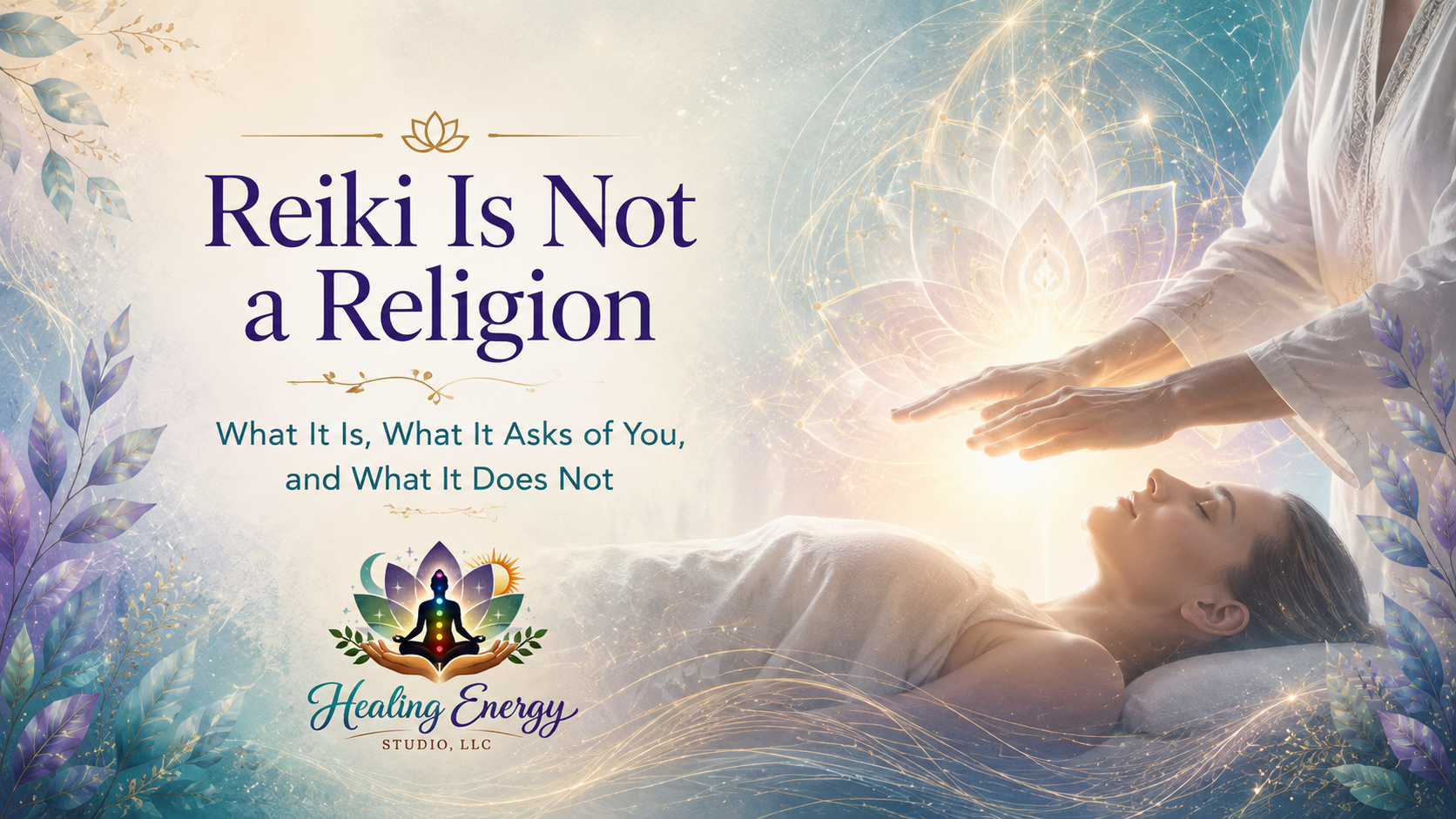
Reiki Is Not a Religion: What It Is, What It Asks of You, and What It Does Not
Reiki is spiritual, but it is not a religion. It does not require conversion, worship, or belief in a particular deity. Learn what Reiki actually asks of the person receiving it—and what it does not.
One of the questions people quietly carry into energy work is not really about Reiki technique at all.
It is about faith.
Is Reiki a religion? Does receiving Reiki mean participating in someone else’s spiritual beliefs? Do you have to believe in chakras, spirit guides, reincarnation, Buddhism, or anything else in order for a session to make sense?
For people with strong religious backgrounds, those questions can matter deeply.
So I want to answer them clearly.
Reiki is not a religion.
It has spiritual roots and can be practiced in a deeply spiritual way, but it does not require worship, doctrine, conversion, membership, or belief in a particular deity.
WHAT REIKI ACTUALLY IS
Reiki is a Japanese system of spiritual practice and hands-on or hands-near healing that developed through Mikao Usui in the early twentieth century.
In a typical session, the practitioner places hands lightly on or just above the body and allows Reiki to flow with the intention of supporting balance, relaxation, and the recipient’s natural healing response.
That definition does not involve religious conversion or doctrine because neither is required for the practice.
Traditional Reiki teachings include meditation, self-practice, ethical precepts, and spiritual development. Those elements can feel spiritual because they are.
Spiritual, however, does not automatically mean religious.
SPIRITUALITY AND RELIGION ARE NOT THE SAME THING
Religion generally involves an organized system of beliefs, teachings, rituals, community, and often a particular understanding of God or the sacred.
Spirituality can be much broader.
A person may experience spirituality through prayer, nature, meditation, art, service, intuition, silence, religious worship, or a felt relationship with something larger than themselves.
Reiki can sit within that wider spiritual space without asking a person to leave their own faith behind.
A Christian can receive Reiki.
A Buddhist can receive Reiki.
A Muslim, Hindu, Jewish, agnostic, atheist, or spiritually curious person can receive Reiki.
Receiving Reiki does not require adopting the practitioner’s worldview.
WHAT REIKI ASKS OF THE PERSON RECEIVING IT
Very little.
You do not have to understand Reiki.
You do not have to “believe hard enough.”
You do not have to visualize correctly.
You do not have to pray to anyone.
You do not have to accept a new theology.
You can simply rest and receive the session.
That simplicity is one of the things I appreciate most about Reiki.
The recipient does not need to perform spirituality for the practitioner.
WHAT ABOUT THE REIKI PRECEPTS?
Mikao Usui’s system included a set of ethical or contemplative principles commonly known as the Reiki precepts.
Translations vary, but they generally encourage practitioners not to be consumed by anger or worry, to practice gratitude, work honestly, and be kind to others.
Those are spiritual principles, but they are not a creed.
They do not tell a person which God to worship.
They do not tell a person what happens after death.
They do not require rejection of another religion.
They function more like a daily practice of character and awareness.
REIKI DOES NOT REQUIRE CALLING IN SPIRITS OR BEINGS
This is an important distinction because modern energy-healing communities are diverse.
Some practitioners incorporate angels, guides, ancestors, crystals, oracle cards, chakra systems, prayer, or other spiritual practices into their work.
Those practices may be meaningful to them.
But they are not required in order for something to be Reiki.
A Reiki session can be very simple: practitioner, recipient, intention, hands, quiet, and Reiki.
That matters because sometimes people encounter one practitioner’s personal spiritual style and assume that everything surrounding the session is part of Reiki itself.
It is not necessarily so.
A practitioner’s additions are not the same thing as the core practice.
CAN REIKI FIT WITH CHRISTIANITY OR ANOTHER FAITH?
Different religious communities answer that question differently, and I would never tell someone what their faith must permit.
That is a conversation a person may want to have with their own clergy, spiritual adviser, or conscience.
What I can say is that Reiki itself does not require a person to worship another deity, renounce their religion, or accept a competing religious doctrine.
Many people understand Reiki as a form of compassionate, prayerful, or spiritually grounded care that fits comfortably alongside their existing beliefs.
Others prefer not to participate in any energy-healing practice for theological reasons.
Both choices deserve respect.
I do not think anyone should be pressured spiritually in order to receive care.
WHAT REIKI DOES NOT ASK ME TO DO AS A PRACTITIONER
Reiki does not ask me to diagnose disease.
It does not ask me to replace someone’s physician, therapist, medication, church, or spiritual community.
It does not require me to tell a client what they should believe.
It does not give me authority over another person’s spiritual life.
My role is to create a grounded, compassionate space and practice Reiki within the scope of what I actually offer.
That boundary is important to me.
A person should be able to receive support without feeling that their beliefs are being recruited, corrected, or judged.
WHY REIKI CAN FEEL SPIRITUAL EVEN WITHOUT RELIGION
Reiki sessions are often quiet.
People slow down.
They notice their breathing.
They notice sensations in the body.
They may feel warmth, tingling, emotion, stillness, peace, or a sense of connection.
Those experiences can feel spiritual because deep stillness itself can feel spiritual.
We do not always need to turn that experience into a doctrine.
Sometimes a moment of peace is simply a moment of peace.
Sometimes it feels like prayer.
Sometimes it feels like energy.
Sometimes it feels like the nervous system finally softening.
Sometimes the person has no words for it at all.
I am comfortable leaving room for that mystery.
WHAT SCIENCE SAYS—AND DOES NOT SAY
Reiki is also studied as a complementary health practice.
That scientific uncertainty does not turn Reiki into a religion.
It simply means that the mechanism and clinical effects remain questions for research.
Science and religion answer different kinds of questions.
Reiki does not need to be classified as one simply because science has not fully explained the other.
THE SIMPLEST WAY I CAN SAY IT
Reiki is a spiritual healing practice, not a religion.
You can bring your faith with you.
You can bring your questions with you.
You can bring no particular spiritual belief at all.
You do not have to become anything new in order to receive Reiki.
And for me, that openness is part of what makes the practice so beautiful.
SOURCES FOR CURIOUS READERS
National Center for Complementary and Integrative Health. Reiki.
Vitale A. Reiki: Defining a Healing Practice for Nursing. 2020.

Ground, Receive & Reset: A Reiki Circle for When You’re Carrying Too Much
When life feels heavy, give yourself a quiet moment to breathe, rest, and receive. This recorded Reiki circle offers guided grounding, gentle visualization, and space to return to yourself.
Some days, you arrive at the evening still carrying everything: the unfinished tasks, the conversation you keep replaying, the needs of other people, and the pressure to keep going.
You don’t have to sort it all out before you rest.
This Reiki circle, Ground, Receive & Reset, is an invitation to pause, soften, and give yourself time that asks nothing more of you.
Our intention is simple:
I release what is heavy and return to myself.
Watch the Reiki circle
When life feels heavy, give yourself a quiet moment to breathe, rest, and receive. This recorded Reiki circle offers guided grounding, gentle visualization, and space to return to yourself.
A quiet space to receive
I’m April Byrd, founder of Healing Energy Studio, LLC and a Usui Holy Fire® III Reiki Master Teacher. In this recorded circle, I guide you through settling into your body, connecting with your breath, and making space to receive Reiki.
The session includes a gentle light visualization through the body and chakras, grounding imagery, and reflection around three invitations:
Ground. Notice the support beneath you and allow yourself to set down some of what you’ve been carrying.
Receive. Give yourself permission to rest without needing to earn it, accomplish something, or create a particular experience.
Reset. Return to your breath, your body, and the quiet sense of yourself beneath the demands of the day.
There are also intentional periods of quiet with soft music. You don’t need to follow every word. You’re welcome simply to rest.
Make yourself comfortable
Choose a place where you can sit or lie down comfortably. Silence notifications, adjust your blanket or pillows, and let yourself settle in.
You may close your eyes or keep them open. Shift positions whenever you need to. There is no experience you have to produce and no sensation you need to feel.
During the Reiki portion, a peaceful image remains on screen while I am off camera. The guidance and music continue, with room for stillness between the words.
As the session ends, give yourself a few moments to return at your own pace. You might stretch, sip some water, or simply notice how you feel without needing to interpret it.
Return whenever you need a pause
Although this circle was recorded in September, its intention belongs to any day when life feels heavy.
You don’t need to become someone new. Sometimes a reset is simply making room to come back to yourself.
Save this experience and return whenever you’d like another quiet moment.
Join me for a live Reiki circle
If you’d like to receive Reiki in a live group setting, you’re warmly invited to an upcoming online circle. Join from a comfortable space at home, with your camera off and no prior Reiki experience needed.
Explore upcoming Reiki circles and reserve your place.
I’d love to share this space with you.
With warmth,
April
Healing Energy Studio, LLC

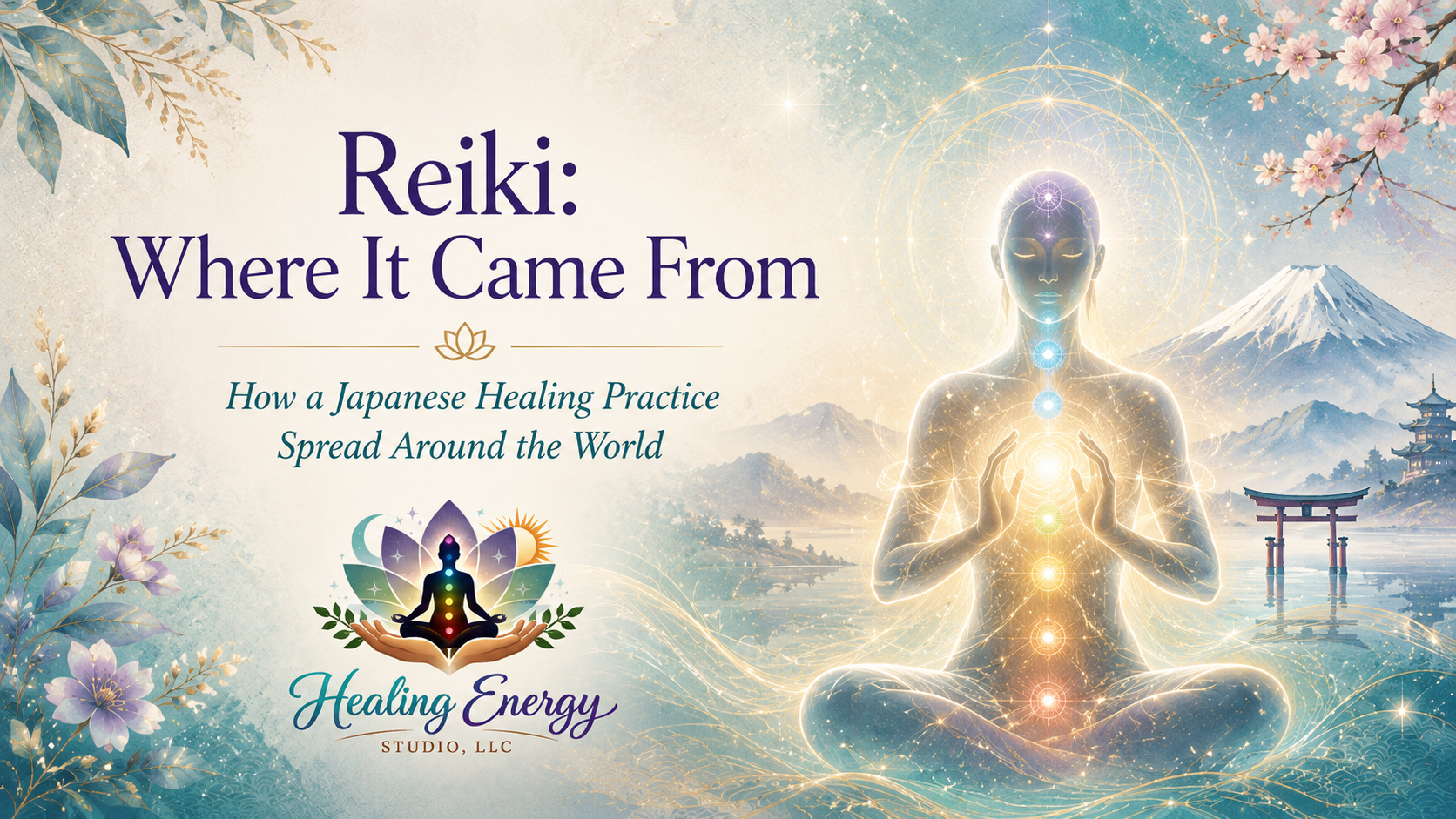
Reiki: Where It Came From and How a Japanese Healing Practice Spread Around the World
Reiki began in Japan in the early twentieth century and traveled through teachers, lineages, and cultures to become a global healing practice. Explore Mikao Usui, the Reiki precepts, how Reiki spread, and what has changed along the way.
Reiki is often described today as an energy-healing practice, but that simple description leaves out a fascinating history.
It began in Japan in the early twentieth century and is most closely associated with Mikao Usui, a Japanese spiritual practitioner and teacher. From there, Reiki traveled through students and lineages, crossed cultures and languages, and eventually became one of the most widely recognized energy-healing practices in the world.
Understanding that history matters because Reiki did not appear out of nowhere, and it was not created as a modern wellness trend.
It developed in a particular cultural and spiritual context.
WHO WAS MIKAO USUI?
Mikao Usui was born in Japan in 1865 and is generally recognized as the founder of the system that later became known internationally as Reiki.
Historical accounts differ on some details of his life, and Reiki traditions have sometimes passed stories orally that are difficult to verify. What is consistent across modern historical reviews is that Usui developed a system of spiritual practice and healing in Japan in the early 1920s.
Usui’s system included more than hands-on healing. It also included meditation, personal discipline, ethical principles, spiritual development, and practices intended to cultivate awareness and balance.
That is important because modern Reiki is sometimes reduced to “putting hands over someone.” Historically, it was a broader practice.
THE REIKI PRECEPTS
One of the best-known parts of Usui’s system is a short set of guiding principles often called the Reiki precepts.
Different schools translate them differently, but they commonly center on themes such as not giving oneself over to anger or worry, practicing gratitude, working honestly, and treating others with kindness.
These are not doctrines that require membership in a religion.
They are ethical and contemplative practices.
For many Reiki practitioners, the precepts are as important as the hands-on work because they point to the idea that healing begins with how we live, respond, and relate to the world.
HOW DID REIKI SPREAD?
Usui taught students in Japan. One of the most influential was Chujiro Hayashi, a retired naval officer and physician who developed a more structured clinical approach to Reiki practice and training.
Hayashi later taught Hawayo Takata, a Japanese-American woman born in Hawaii who became enormously important to Reiki’s spread outside Japan.
Takata brought Reiki to Hawaii and the continental United States and trained students who went on to teach others.
This transmission through teachers and students is why Reiki practitioners often speak about lineage.
A Reiki lineage is essentially the chain of teachers connecting a practitioner back through earlier teachers to the practice’s Japanese roots.
Lineage does not mean every modern Reiki school teaches exactly the same way.
Quite the opposite.
As Reiki moved through countries and cultures, different schools developed different language, symbols, teaching structures, spiritual interpretations, and styles of practice.
WHAT DOES THE WORD “REIKI” MEAN?
The Japanese word is usually written with two characters: rei and ki.
In modern Reiki teaching, “rei” is often translated as universal or spiritual, while “ki” refers to vital energy or life energy.
That is why Reiki is commonly translated into English as “universal life energy” or “universal life-force energy.”
Translations are never perfect, especially when spiritual and philosophical concepts cross languages.
The important point is that ki is related to the broader East Asian concept of vital energy—the same family of ideas discussed as qi in Chinese traditions.
REIKI WAS SHAPED BY JAPANESE CULTURE
To understand early Reiki, it helps to remember the Japan in which Usui lived.
Japanese spiritual life included influences from Buddhism, Shinto, meditation traditions, martial disciplines, folk healing, and practices concerned with cultivation of mind and spirit.
Reiki emerged within that cultural landscape.
That does not mean Reiki itself is Buddhism or Shinto.
It means spiritual practices are always shaped by the cultures around them.
When Reiki later moved into Western countries, some of its language changed. New explanations appeared. Chakra language became more common in some schools even though chakras come primarily from Indian traditions rather than classical Japanese Reiki.
That blending is one reason modern Reiki can look different from one practitioner to another.
WHAT HAPPENS IN A REIKI SESSION?
The basic practice is remarkably simple.
A practitioner places hands lightly on or just above the body with the intention of supporting balance, relaxation, and the recipient’s natural healing response.
That clinical description is intentionally neutral.
Traditional Reiki language describes the practitioner as allowing universal life-force energy to flow rather than forcing or directing a specific outcome.
Many practitioners describe Reiki less as “doing something to” a client and more as creating a space in which the body, mind, and spirit can receive support.
HOW TRAINING WORKS
Modern Reiki training is commonly divided into levels.
The exact structure varies by school, but many systems include a first level focused on self-treatment and hands-on practice, a second level that introduces symbols and distance practice, and an advanced or master level focused on deeper practice and teaching.
A distinctive part of Reiki training is the attunement or ignition process.
Traditional Reiki schools regard attunement as an energetic transmission from teacher to student that opens or strengthens the student’s ability to work with Reiki. Holy Fire III Reiki believes the attunements are direct from Source, removing the transmission from the teacher, thus eliminating any influence that teacher might have so the attunement remains the purest energy.
Within Reiki tradition, it is considered a central part of training rather than merely symbolic instruction.
I will be teaching Usui Holy Fire III Online Certification courses. These will be available in the Appointments area.
REIKI AND MODERN HEALTHCARE
As Reiki spread internationally, it also entered hospitals, hospice programs, nursing, cancer-support services, wellness centers, and private practices.
Peer-reviewed nursing literature has discussed Reiki as a complementary practice and has emphasized the need for healthcare professionals to understand what it is, how it is taught, and how patients may use it alongside conventional care.
That is part of the story too.
Reiki’s history is not the same thing as proof of clinical effectiveness.
A practice can have cultural, spiritual, and experiential significance while still being the subject of ongoing scientific study.
WHAT I FIND MOST INTERESTING ABOUT REIKI’S HISTORY
Reiki has survived more than a century of cultural change.
It moved from Japan to Hawaii, across the United States, throughout Europe, and into many other parts of the world.
It has been practiced in homes, hospitals, hospice rooms, meditation spaces, and private healing studios.
It has been interpreted spiritually, clinically, philosophically, and personally.
And yet the center of the practice remains surprisingly simple:
Be present.
Place the hands.
Allow rather than force.
Support balance.
Practice with intention and compassion.
For me, understanding the history makes Reiki feel less mysterious in one way and more meaningful in another.
It reminds me that Reiki is not a random collection of modern spiritual ideas.
It is a living practice with roots, teachers, traditions, and a history of people passing it from one person to another.
SOURCES FOR CURIOUS READERS
Vitale A. Reiki: Defining a Healing Practice for Nursing. 2020.
Lee MS, Pittler MH, Ernst E. A Systematic Review of the Therapeutic Effects of Reiki. 2009.
National Center for Complementary and Integrative Health. Reiki.

Reiki I Online Certification Is Now Open: Learn Reiki for Yourself!
You can learn Reiki for yourself. My new online Reiki I course brings together self-paced lessons, guided practice, a workbook, and a live Online Placement to help you begin a personal Reiki practice—with room to learn, reflect, and grow.
What if you could bring Reiki into the ordinary moments of your life—the quiet before the house wakes up, the transition after a demanding workday, or the evening when you finally have a little time for yourself?
If you’ve been curious about Reiki and wondered whether you could learn it, I’m excited to share something with you:
My Usui/Holy Fire® III Online Reiki I course is officially live at Healing Energy Studio.
This course introduces you to Reiki through learning, reflection, and your own experience. With self-paced online lessons, a supporting workbook, guided practices, and a scheduled live Reiki I Online Placement, you’ll begin building a personal practice you can bring into everyday life.
A Reiki practice can begin with you
You may have experienced a Reiki session and wanted to understand it more deeply. Maybe you’ve been following along with my work and feel curious about learning. Or perhaps you’re drawn to having a regular practice that makes space for quiet, reflection, and care for yourself.
Reiki I is a place to begin.
You don’t need previous Reiki training, a plan to become a practitioner, or certainty about where this will lead. You can start with an interest in learning and a willingness to make time for your own experience.
For some students, this will become a meaningful personal practice. For others, it may be the first step toward further Reiki training. Both are welcome.
What you’ll learn
The course guides you through the foundations of Reiki and gives you opportunities to put what you’re learning into practice.
You’ll explore:
Reiki’s history and principles, including the Reiki Ideals and how they can become reminders in daily life.
Preparation for your Reiki I Online Placement, with guidance on what to expect.
Meditation and traditional Reiki techniques, including Gassho and Kenyoku.
Awareness and intuitive practice, through Byosen self-scanning and Reiji-ho.
Self-Reiki hand positions and guided practice, so you can begin practicing on yourself.
Reflection and integration, using your workbook to notice your experience and support continued learning.
You’ll also receive the prerecorded Ocean of Holy Love Experience as part of your preparation.
There is room here to pause, practice, and reflect. Your workbook is designed to remain a reference you can return to as your practice develops.
Online learning, with a live Placement
The course combines the flexibility of self-paced lessons with a scheduled live Reiki I Online Placement.
A Placement is an important part of the Usui/Holy Fire® III training process. The course introduces it, explains how to prepare, and guides you through scheduling your appointment.
You’ll move through the lessons in order, completing the preparation before your Placement and continuing into the self-practice lessons afterward.
That structure gives you a clear path while allowing time to absorb what you’re learning. You can make space for study around your life, then give the practices the attention they deserve.
After completing the course requirements, you’ll submit your Reiki I certificate request.
Is this course right for you?
This course may be a meaningful next step if you:
Want to learn Reiki for your own self-care and spiritual practice.
Have enjoyed receiving Reiki and feel ready to explore it more deeply.
Are a parent interested in learning a practice you can use for yourself and your own children.
Prefer online learning with a clear sequence and guided practices.
Feel drawn toward becoming a Reiki practitioner and want to begin with the foundations.
This Reiki I course focuses on personal practice and can also be used with your own children. Practitioner certification begins at Reiki II. You’re welcome to take Reiki I simply for yourself, without committing to further training.
An invitation from me
Healing Energy Studio grew from my own experience with this work and my desire to share it with care.
As a Certified Usui Holy Fire® III Reiki Master Teacher, I value learning that leaves room for curiosity, questions, and individual experience. My approach honors your pace, your comfort, and the understanding that people experience this work differently.
I’m excited to offer a way for you to explore Reiki beyond receiving a session—to learn the foundations and begin making the practice your own.
If you’ve been wondering, “Could I learn Reiki?” this is your invitation to take a closer look.
Reiki I is now open. I would be honored to welcome you.
Sending Love & Light,
April
Healing Energy Studio, LLC
Reiki is a complementary practice for spiritual wellness and self-care. It does not replace medical or mental health care.

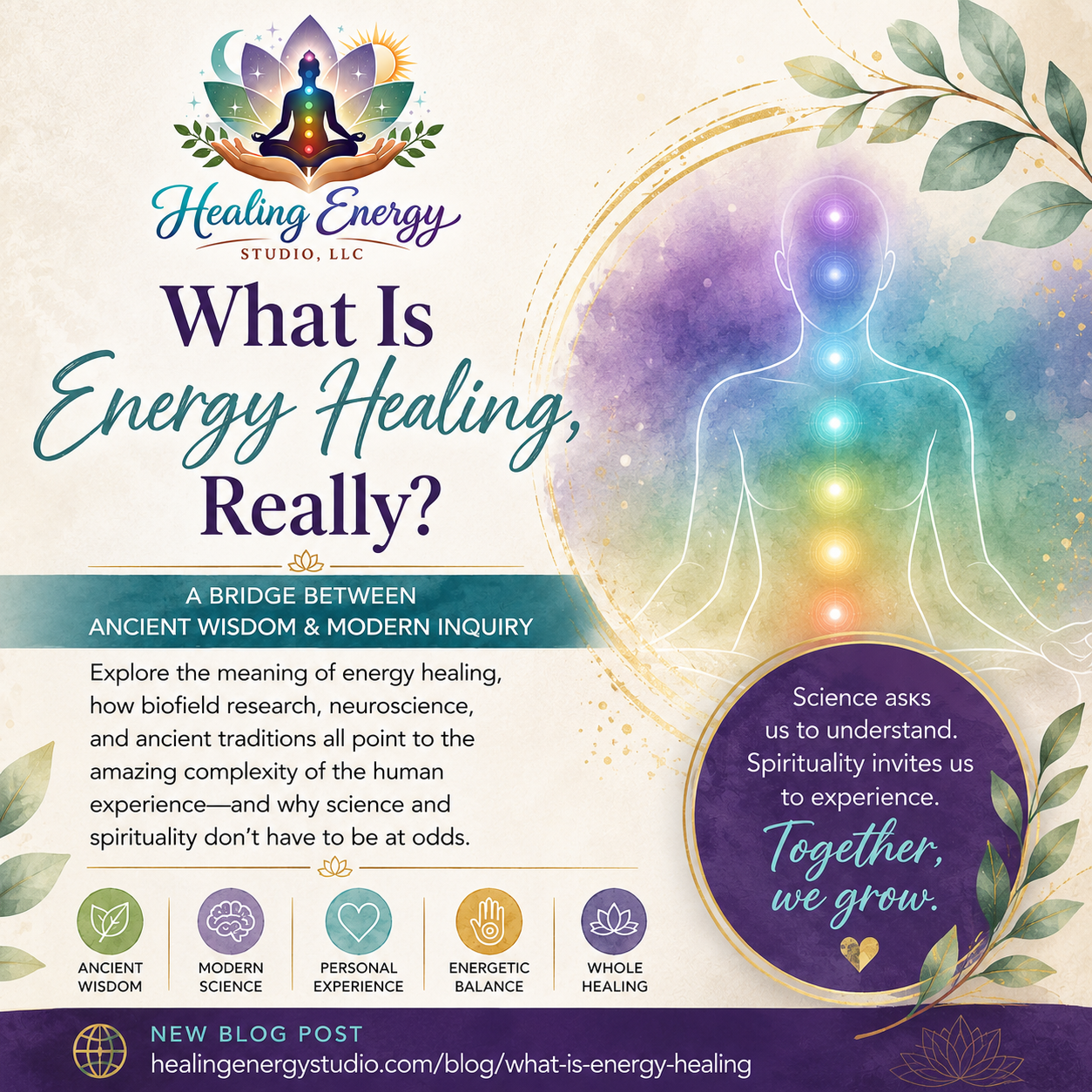
What Is Energy Healing, Really?
Energy healing has roots in traditions that long predate modern medicine, but science is now asking its own questions about biofields, electrical signaling, and the complex ways living systems communicate. Explore what we know, what traditions have taught, and what remains beautifully unexplained.
A Bridge Between Ancient Wisdom and Modern Inquiry
For most of human history, people have understood the body as more than simply a collection of organs, muscles, bones, and chemicals.
Different cultures developed different words for something that seemed to animate living beings: qi in Chinese traditions, prana in Indian traditions, ki in Japan, and other concepts of breath, spirit, vitality, or life force throughout the world.
Today, people who practice Reiki and other forms of energy healing may use words such as energy, life-force energy, subtle energy, biofield, vibration, frequency, or energetic balance.
Those words can sound strange if your only exposure to healing has been through conventional Western medicine.
But here is where the conversation becomes interesting.
Modern science also recognizes that the human body is not simply chemical. We are electrical. We generate measurable electromagnetic activity. Cells communicate through electrical as well as chemical processes. Our brains and hearts create signals strong enough to be measured outside the cells producing them.
None of that proves every traditional belief about energy.
But it does make the conversation about human energy much more interesting than simply dismissing it as “woo-woo.”
So What Is Energy Healing?
At its simplest, energy healing is based on the idea that the human being has an energetic component and that supporting balance within that system may support the whole person.
Different modalities approach this in different ways.
Reiki practitioners traditionally work with universal life-force energy. Healing Touch and Therapeutic Touch developed somewhat differently but also work from the idea of interacting with a person's energetic field. Qigong includes practices designed to cultivate and regulate qi. Other traditions work with chakras, meridians, breath, prayer, intention, sound, movement, or touch.
These traditions do not all mean exactly the same thing by “energy.”
That is important.
We sometimes try to take spiritual concepts developed over thousands of years and force them into a single modern scientific definition. They may overlap, but they do not necessarily describe the same phenomenon.
Science has developed its own language.
Researchers studying practices such as Reiki, Healing Touch, and Therapeutic Touch commonly use the term biofield therapies. A major review published in the International Journal of Behavioral Medicine described Reiki, Therapeutic Touch, and Healing Touch within this category and reviewed 66 clinical studies involving biofield therapies. The review reported promising findings in some areas—particularly pain—and more mixed evidence in others, while also emphasizing the need for stronger research.
The important point is not that science has solved the mystery.
It hasn't.
The important point is that people are studying it.
What Is a Biofield?
This is where the scientific and spiritual conversations begin moving closer together.
A group of researchers writing about biofield physiology proposed the biofield as a framework for studying spatially distributed fields that living systems generate and respond to.
Their discussion included things we already know exist, such as the electrical and magnetic activity produced by the heart and nervous system, along with less-understood phenomena such as ultraweak photon emissions from living cells.
We routinely measure some of these biological signals.
An ECG measures electrical activity associated with the heart.
An EEG measures electrical activity in the brain.
Magnetocardiography and magnetoencephalography can detect magnetic fields associated with cardiac and neural activity.
Researchers also study electrical patterns involved in development, cellular organization, tissue injury, and regeneration.
So when someone says, “The body has energy,” that statement is not inherently unscientific.
The much harder question is:
Does the measurable electrical and electromagnetic activity of the body explain what energy healers experience and work with?
We don't know.
And I think we don't know is an incredibly interesting place to begin.
Science and Spirituality Ask Different Questions
Science is designed to observe, measure, test, reproduce, and challenge ideas.
That has given humanity extraordinary knowledge.
But science can only investigate something once we have a way to observe or measure it.
That limitation does not make science inadequate. It simply means that scientific knowledge evolves alongside our ability to ask better questions and develop better tools.
Spirituality approaches life differently.
Spirituality allows us to experience something before we can explain it.
Love existed before we could watch parts of the brain respond to attachment.
Meditation existed thousands of years before researchers began measuring its effects on the nervous system and brain.
Human beings practiced breathing techniques, prayer, laying on of hands, fasting, movement, herbs, and other healing traditions long before laboratories existed.
Some traditional beliefs eventually find scientific explanations.
Some turn out to have been misunderstood.
Some remain mysteries.
I don't think we have to choose between those possibilities.
The Body May Be More Complex Than One Model Can Explain
One of the things I find fascinating about modern medicine is how much our understanding of the body continues to expand.
For a long time, biology was largely explained through chemistry: hormones, neurotransmitters, proteins, enzymes, DNA.
All of those things remain enormously important.
But researchers now also study bioelectric signaling, electromagnetic activity, psychoneuroimmunology, epigenetics, interoception, neuroplasticity, the microbiome, mind-body interactions, and many other systems that would have sounded very different in medical conversations generations ago.
Researchers have even proposed “biofield science” as an emerging discipline for investigating biological organization beyond purely molecular explanations.
That does not mean every proposed explanation is correct.
It means the conversation is still happening.
And that is exactly where curiosity belongs.
What About Reiki?
Reiki is one form of energy work, and it is the modality I use most frequently in my own practice.
During Reiki, a practitioner generally places their hands lightly on the body or holds them just above it with the intention of supporting the recipient's natural healing response.
The National Center for Complementary and Integrative Health describes Reiki as a complementary health approach based on the concept of energy supporting the body's natural healing abilities. NCCIH also notes that research results remain inconsistent and that the proposed Reiki energy itself has not been scientifically demonstrated.
I am comfortable holding both parts of that statement.
Science has not fully explained Reiki.
And Reiki has been experienced and practiced by people around the world regardless of whether we currently understand its mechanism.
Those ideas can coexist.
Experience Matters Too
This is one of the places where I differ from the idea that something has no value until science can explain exactly how it works.
Research matters.
Evidence matters.
Critical thinking matters.
But human experience matters too.
When someone lies on my Reiki table and feels warmth where my hands are not touching them, that experience matters to them.
When someone becomes deeply relaxed after arriving tense and overwhelmed, that matters.
When someone experiences an emotional release they did not anticipate, that matters.
It does not automatically tell us why it happened.
And it certainly doesn't mean that every sensation must have a supernatural explanation.
But curiosity allows us to ask the question instead of immediately dismissing the experience.
Maybe some of what happens during energy work involves the nervous system.
Maybe attention and intention matter.
Maybe the therapeutic environment matters.
Maybe expectation plays a role.
Maybe biological fields are involved.
Maybe consciousness itself has aspects we do not yet understand.
Maybe more than one of those things is true.
We Don't Have to Choose a Side
This series is going to explore that space.
We will look at Reiki research, biofields, nervous-system regulation, chakras, qi and prana, meditation, consciousness, epigenetics, intuition, healing traditions, hospital programs, oncology, prayer, the work of people such as Bruce Lipton, Joe Dispenza, and Sue Morter, and some of the questions science has not yet answered.
I am not interested in using science to prove spirituality.
And I am not interested in rejecting science because it cannot yet explain every spiritual experience.
I am interested in the bridge between them.
Because perhaps one of the most valuable things we can say about healing is:
There is a great deal we know. There is a great deal we are beginning to understand. And there is still a great deal that remains beautifully mysterious.
That feels like a very good place to begin.
A Few Sources for Curious Readers
Jain S, Mills PJ. Biofield therapies: helpful or full of hype? A best evidence synthesis. International Journal of Behavioral Medicine. The review evaluated 66 clinical studies of several biofield therapies and reported evidence ranging from promising to inconclusive depending on the outcome studied.
Hammerschlag R, Levin M, McCraty R, et al. Biofield Physiology: A Framework for an Emerging Discipline. The paper explores biological electromagnetic activity, bioelectric signaling, ultraweak photon emission, and the possibility of a broader biofield physiology framework.
Rubik B, Muehsam D, Hammerschlag R, Jain S. Biofield Science and Healing: History, Terminology, and Concepts. This paper examines the history and terminology of biofield concepts and their relationship to energy medicine.
The National Center for Complementary and Integrative Health also maintains an overview of Reiki and the current state of conventional scientific evidence.

A Free Reiki Circle for Estranged & Alienated Parents
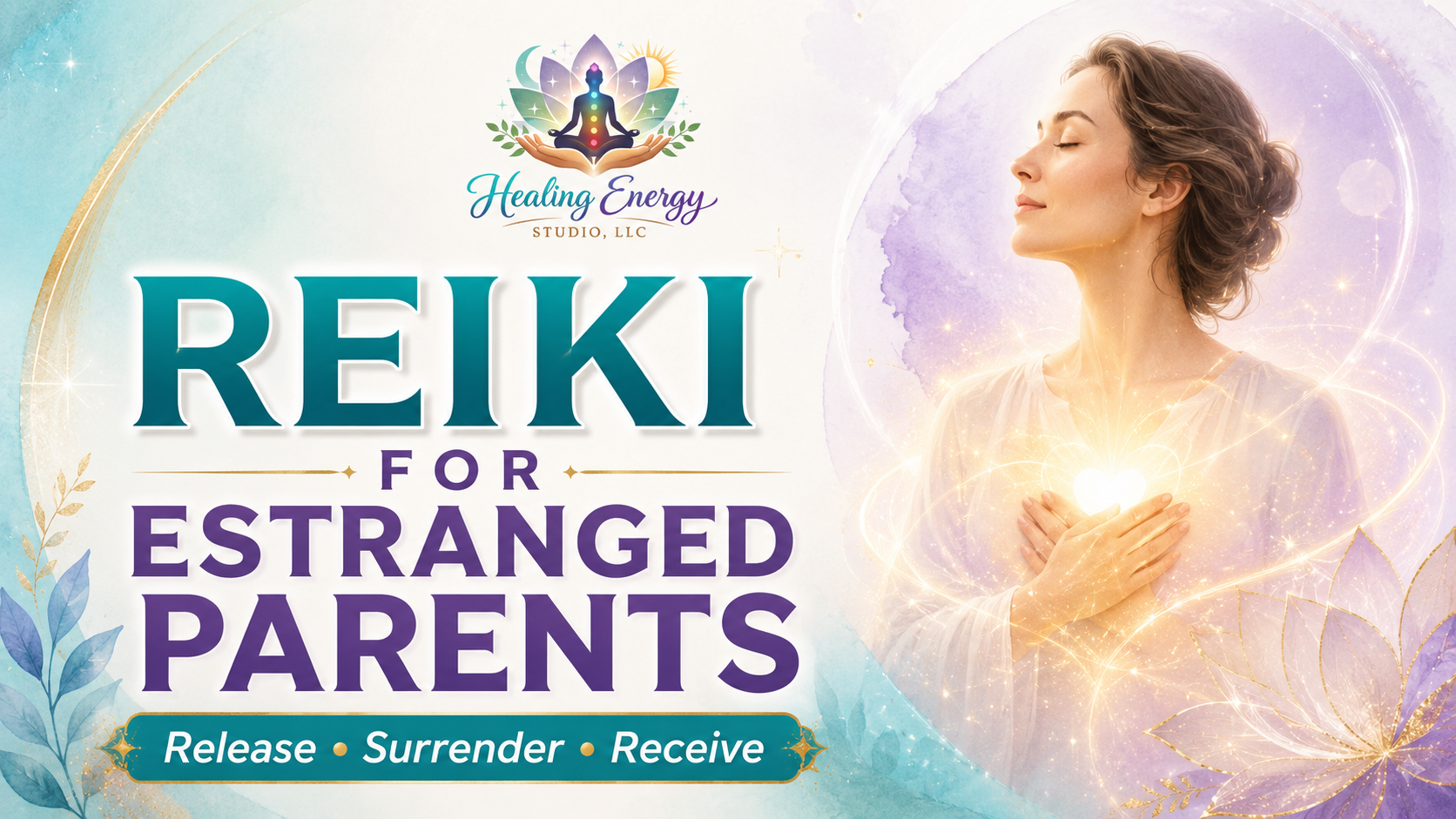
Estrangement from a child or grandchild can bring grief, confusion, guilt, anger, and a love that does not simply disappear. This free Reiki circle was created specifically for estranged and alienated parents who need a quiet place to breathe, release some of what they are carrying, and reconnect with themselves. Watch the full session, subscribe for future Reiki experiences, and learn how to join upcoming live circles.
Estrangement from a child, grandchild, or someone you love deeply can create a kind of grief that is difficult to explain.
There may still be love. There may still be hope. But there can also be sadness, anger, confusion, guilt, unanswered questions, and the exhaustion that comes from carrying all of those things at once.
I created this Reiki circle specifically for parents and grandparents experiencing estrangement or alienation.
This free guided session is a space to slow down, breathe, receive Reiki, and gently release some of what has become attached to the love you still carry.
You do not have to solve the relationship during this session.
You do not have to decide what happens next.
You do not have to stop loving anyone.
For a little while, you are simply invited to receive.
Watch the Free Reiki Circle
You can watch the full session here.
During the circle, we move through grounding, breathwork, Reiki, loving light, emotional release, surrender, self-trust, and a gentle intention of love for the people we miss without attempting to control their choices or their path.
One of the intentions woven throughout the session is learning that healing yourself does not mean giving up on the person you love.
Peace is not permission for what hurt you.
Healing is not forgetting.
And continuing to live your own life does not mean that you have stopped loving someone who is absent from it.
Subscribe for More Reiki Sessions
I will continue sharing Reiki circles, guided healing experiences, and other supportive content through the Healing Energy Studio YouTube channel.
If this session speaks to you, I would love to have you subscribe so you can easily find future sessions as they are released:
http://www.youtube.com/@HealingEnergyStudioLLC
Subscribing also helps Healing Energy Studio reach more people who may be quietly carrying grief, stress, emotional pain, or a need for support.
Join a Reiki Circle Live
Some Reiki circles will also be offered as live online events.
Joining live gives you the opportunity to intentionally set aside the time, enter the Reiki space with others who may be walking a similar path, and experience the session as it unfolds.
You can see upcoming Reiki circles and reserve your place here:
https://healingenergystudio.as.me/ReikiCircles
The next Estrangement Reiki Circle is September 9, 2026, and registration is $5.
Additional circles will focus on different emotional, spiritual, and seasonal themes, so check the schedule regularly for new events.
You Are Welcome Here
If you are navigating estrangement, I want Healing Energy Studio to be a place where you do not have to explain why you still love someone who has hurt you or why grief can exist alongside hope.
There is room for all of it.
There is also room for your own healing.
You are allowed to release some of the weight without releasing the love.
You are allowed to reconnect with yourself.
And you are allowed to have beautiful days while your story is still unfolding.
Watch the free Reiki circle, subscribe to the YouTube channel, and join me live whenever you feel called.
Subscribe on YouTube:
http://www.youtube.com/@HealingEnergyStudioLLC
See upcoming Reiki circles:
https://healingenergystudio.as.me/ReikiCircles

What Is Reiki? A Gentle Introduction to Energy Healing
Curious about Reiki? Learn what this gentle energy-healing practice involves, what you may experience during a session, and how in-person and remote Reiki can support relaxation, balance, and reconnection.
Reiki is one of the services people ask me about most often, especially when they have never experienced energy healing before.
Some people initially assume Reiki is a type of massage. Others wonder whether they need to understand chakras, meditate, or believe in energy healing for a session to be worthwhile.
The truth is that Reiki is a gentle, non-invasive wellness practice that asks very little of the person receiving it.
You remain fully clothed, rest comfortably, and allow yourself time to slow down.
What Does Reiki Mean?
Reiki is pronounced “ray-key.”
The word comes from Japanese terms commonly translated as universal or spiritual energy and vital life energy. Reiki practitioners use a light-touch or hands-above-the-body approach with the intention of supporting relaxation, balance, and overall well-being.
There is no massage, manipulation, or pressure applied to the body.
During an in-person session, my hands may rest lightly on or above different areas of the body, depending on your comfort and consent. Reiki can also be offered remotely, allowing you to receive a session from home.
What Happens During a Reiki Session?
At the beginning of your session, we may briefly discuss how you have been feeling and what you would like support with.
You do not need to arrive with a perfect explanation or a specific goal. Some clients come because they feel stressed, emotionally heavy, disconnected, exhausted, or simply in need of quiet time.
During the Reiki portion of the session, you rest comfortably while I facilitate the energy work.
People may experience:
Deep relaxation
Warmth, coolness, or tingling
A heavy or floating sensation
Emotional release
Colors, images, or memories
A meditative or dreamlike state
A feeling of greater calm or clarity
No particular sensation beyond resting quietly
There is no correct way to experience Reiki. Each person and each session can feel different.
Reiki and the Chakra System
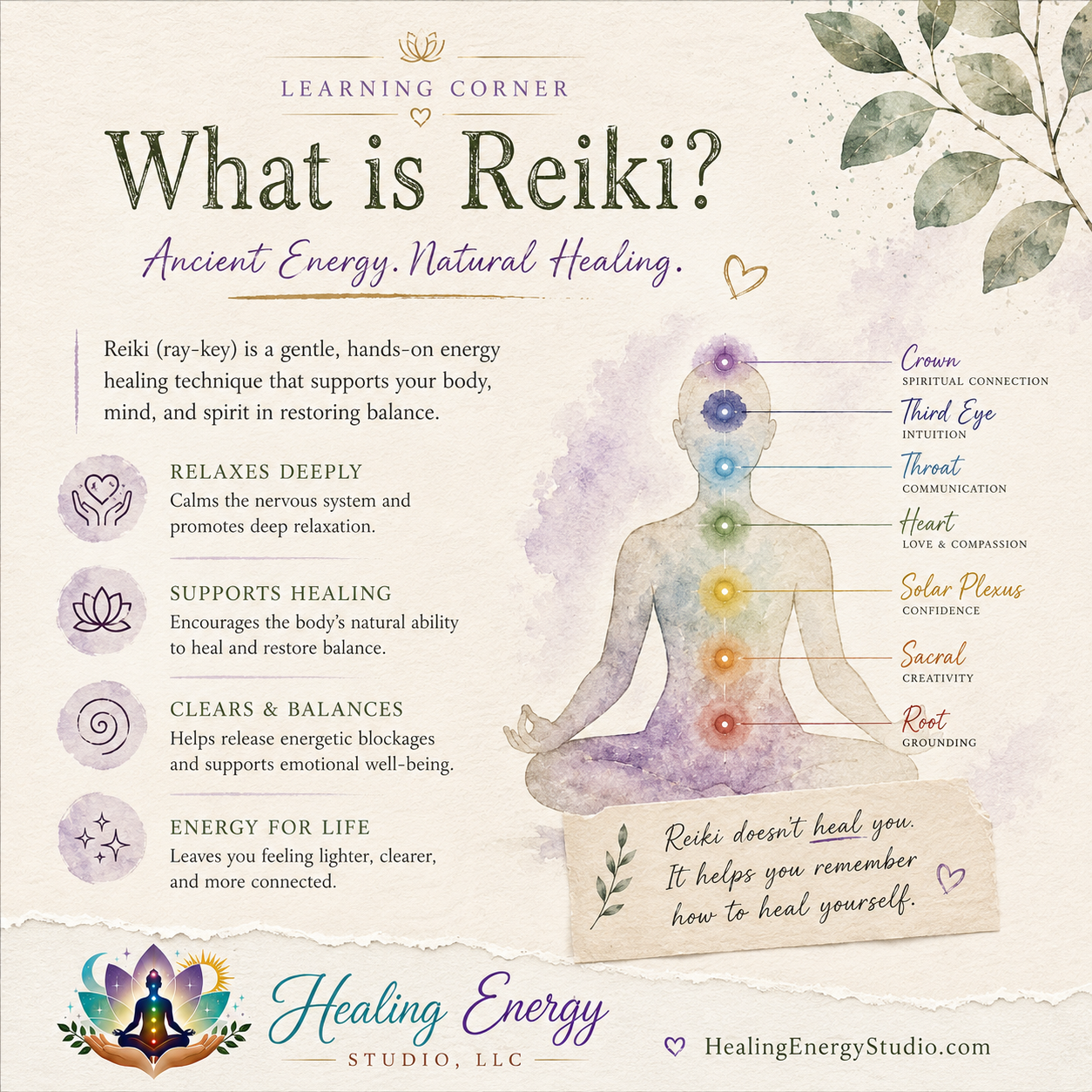
Reiki is often used alongside awareness of the chakra system.
The seven main chakras are traditionally associated with different areas of emotional, energetic, and spiritual experience:
Root Chakra: grounding, security, and stability
Sacral Chakra: creativity, emotion, and connection
Solar Plexus Chakra: confidence, personal power, and self-worth
Heart Chakra: love, compassion, and forgiveness
Throat Chakra: communication and authentic expression
Third Eye Chakra: intuition and inner insight
Crown Chakra: spiritual connection and purpose
During a session, I may pay attention to areas that feel out of balance or in need of additional support. You do not need to understand the chakras or identify an imbalance yourself before booking.
What Can Reiki Support?
People often seek Reiki when they would like support with:
Relaxation and stress reduction
Emotional balance
Feeling grounded and centered
Rest during demanding seasons
Reconnecting with themselves
Creating space for reflection
Supporting an ongoing healing journey
Feeling lighter, calmer, or more settled
Reiki does not require you to talk through painful experiences or revisit every detail of the past. For some clients, that makes it a comfortable way to receive gentle support without feeling pressured to explain everything they have been carrying.
Reiki Does Not “Fix” You
I do not believe you are broken or need to be fixed.
Reiki is not about a practitioner healing you from the outside. It is about creating a supportive environment where you can rest, reconnect, and listen more closely to what your own mind, body, emotions, and spirit may need.
A phrase on the graphic for this post says:
“Reiki doesn’t heal you. It helps you remember how to heal yourself.”
For me, that reflects the heart of this work.
The practitioner facilitates the session, but your healing journey remains your own. Reiki can be one supportive part of that journey.
Can Reiki Be Done Remotely?
Yes. I offer remote Reiki sessions for clients who prefer to receive support from home or who do not live near my Idaho locations.
Remote sessions may be offered through Zoom, and you can choose whether to leave your camera on or off. Depending on the service booked, distance Reiki may also be completed without a live call.
Remote Reiki may be especially appealing when you:
Live outside the area
Have limited transportation
Prefer the privacy of your own home
Feel too tired or overwhelmed to travel
Want to rest immediately after the session
Are more comfortable without an in-person appointment
You can settle into your bed, couch, or another quiet place while the session is facilitated remotely.
Do You Have to Believe in Reiki?
You do not need to understand Reiki completely or arrive with absolute certainty.
My own introduction to Reiki began with curiosity and skepticism. I originally thought I was scheduling some kind of massage or bodywork session. That experience surprised me and eventually became part of the path that led me to this work.
You are welcome to be curious.
You are welcome to ask questions.
You are also welcome to approach Reiki simply as an opportunity to slow down, rest, and receive compassionate support.
Is Reiki a Replacement for Medical Care?
No.
Reiki is a complementary wellness practice. It is not intended to diagnose or treat a medical or mental-health condition, and it should not replace care from a physician, therapist, or other licensed professional.
Many people choose to use Reiki alongside their existing medical, mental-health, spiritual, or wellness support.
Reiki Sessions Through Healing Energy Studio
Reiki sessions are available:
In person in Pocatello, Idaho
In person in Lava Hot Springs, Idaho
Remotely by Zoom
You may book Reiki as a stand-alone session or choose an Intuitive Energy Healing session that can incorporate Reiki with other supportive modalities based on your needs.
You do not have to know exactly which option is right before reaching out. Begin with what you would like support with, and we can determine the most appropriate place to start.
Learn more or schedule a Reiki session:

Saturday Is for Slowing Down: Can Reiki Be Done Remotely?
Can Reiki really be offered remotely? Learn what distance Reiki is, how Zoom and no-call sessions work, and how to prepare for a peaceful Reiki experience from home.
Saturday can be a natural invitation to slow down, breathe a little more deeply, and step away from the pressure to keep doing.
When was the last time you gave yourself permission to simply rest?
Rest is not wasted time. It gives your mind and body an opportunity to settle after carrying the stress, emotions, responsibilities, and demands of the week. Even a short pause can help you feel more grounded and connected to yourself.
Reiki offers one gentle way to create that pause.
What Is Reiki?
Reiki is a gentle, non-invasive energy-healing practice intended to encourage relaxation, balance, and a greater sense of well-being.
During a Reiki session, you remain fully clothed and rest comfortably while the practitioner facilitates the session. There is no massage, physical manipulation, or pressure to talk through personal experiences.
People often describe feeling:
Calmer and more relaxed
Lighter or less emotionally burdened
More grounded and centered
Peaceful or deeply rested
More connected to themselves
Every person experiences Reiki differently. Some notice warmth, tingling, heaviness, lightness, colors, emotions, or a meditative state. Others simply feel relaxed. There is no particular sensation you must experience for the session to be meaningful.
Can Reiki Really Be Done Remotely?
This is one of the questions I hear most often.
Yes, Reiki sessions can be offered remotely. Within Reiki practice, energy is understood as not being limited by physical distance, allowing the practitioner and recipient to participate from separate locations.
Many people are surprised by how restful and supportive a remote session can feel. It also gives you the opportunity to receive Reiki without traveling, entering an unfamiliar space, or rearranging more of your day than necessary.
You can participate from your bed, couch, favorite chair, or another quiet place where you feel safe and comfortable.
What Are My Remote Reiki Options?
Healing Energy Studio offers flexible ways to receive remote Reiki based on your comfort and preferences.
Reiki by Zoom
You may join your session through Zoom while relaxing at home.
Your camera can remain on, or you may turn it off if that feels more comfortable. The call provides an opportunity to connect at the beginning and end of the session while still allowing you to rest quietly during the Reiki portion.
Distance Reiki Without a Call
You may also choose a completely private distance Reiki experience with:
No phone call
No Zoom meeting
No camera
No need to speak or participate live
Simply book your session and settle into a comfortable place at the scheduled time. I will facilitate Reiki remotely while you rest wherever you are.
This option may be especially helpful for people who feel tired, overstimulated, private, uncomfortable on camera, or simply uninterested in adding another call to their schedule.
How to Prepare for a Remote Reiki Session
You do not need special equipment or previous Reiki experience.
Before your session, consider creating a comfortable environment where you are less likely to be interrupted. You may choose to:
Silence your phone and notifications
Dim the lights
Lie down or sit comfortably
Use a blanket or pillow
Play quiet music
Keep water nearby
Set a simple intention for the session
There is no need to concentrate, meditate perfectly, or try to make something happen. Your only responsibility is to become comfortable and allow yourself to rest.
Who May Appreciate Remote Reiki?
Remote Reiki can be a good option for people who:
Live outside the Pocatello or Lava Hot Springs area
Prefer receiving support from home
Have limited transportation
Feel uncomfortable attending in person
Have a busy or unpredictable schedule
Want a quiet and private experience
Feel emotionally or physically depleted
Need a gentle opportunity to pause
It can also be helpful during seasons when leaving home feels like one more demand rather than a source of support.
Give Yourself Permission to Pause
You do not have to wait until you are completely overwhelmed before giving yourself rest.
Sometimes the most supportive thing you can do is stop for a moment, breathe, and allow yourself to receive rather than constantly produce, manage, or care for everyone else.
Whether you are nearby or hundreds of miles away, Reiki offers an opportunity to slow down and reconnect with yourself from the comfort of your own space.
Schedule a Reiki Session
Reiki sessions are available remotely and in person through Healing Energy Studio.
In-person sessions are offered in:
Pocatello, Idaho
Lava Hot Springs, Idaho
Remote options are available from wherever you are.
Learn more or schedule your session here:
https://www.healingenergystudio.com/appointments
Wishing you a peaceful and restful Saturday.
Reiki is a complementary wellness practice intended to support relaxation and well-being. It is not intended to diagnose, treat, cure, or replace medical or mental-health care.