

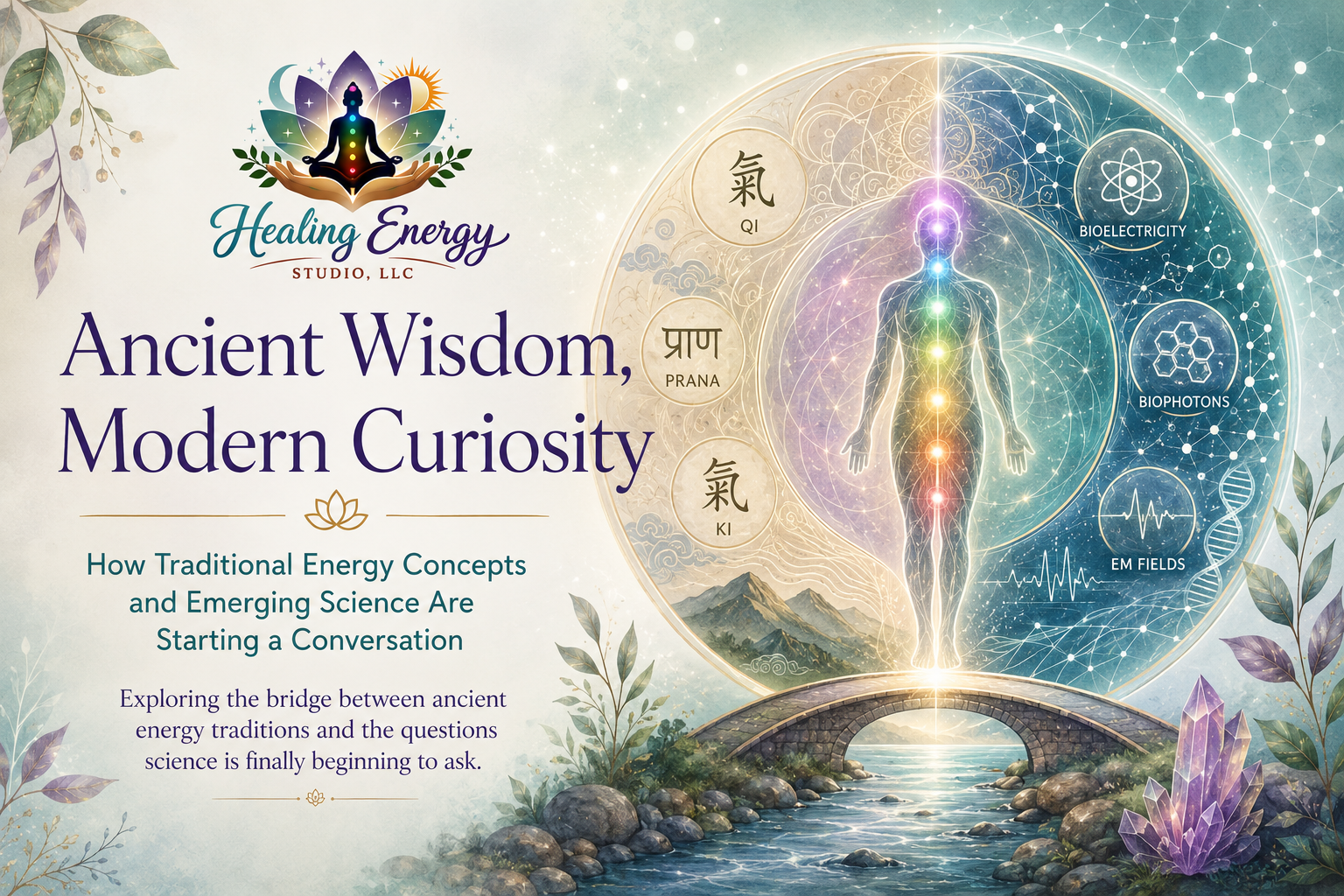
When people hear the phrase “human energy,” the conversation can become surprisingly divided.
Some people immediately think of Reiki, chakras, qi, prana, intuition, or the aura.
Others think of those ideas as spiritual language rather than science.
But there is one part of this conversation that is not controversial at all:
The human body is electrical.
Not metaphorically. Not poetically. Literally.
Every cell in your body depends on differences in electrical charge. Your heart beats because specialized cells generate and conduct electrical signals. Your brain and nerves communicate through electrochemical impulses. Muscles contract because electrical changes across cell membranes trigger molecular events inside the cell.
And increasingly, researchers are looking beyond nerves and muscles to ask a broader question:
What role does bioelectricity play in the way cells grow, organize, communicate, repair, and maintain the structure of the body?
That question takes us into a fascinating part of modern biology—one that feels surprisingly close to conversations energy healers have been having for a very long time.
WHAT DOES “BIOELECTRICITY” ACTUALLY MEAN?
Bioelectricity refers to electrical phenomena generated by living cells.
At the most basic level, cells maintain different concentrations of charged particles—ions such as sodium, potassium, calcium, and chloride—inside and outside their membranes.
That separation of charge creates a voltage across the cell membrane, called the membrane potential.
Ion channels and pumps continually regulate these electrical differences.
Neurons are famous for using rapid changes in membrane voltage to transmit signals, but they are not the only cells with electrical properties.
A 2025 review by GuangJun Zhang and Michael Levin describes bioelectricity as an ancient and fundamental property of living cells, not something limited to nerves and muscles. The authors review evidence that bioelectric signaling participates in cell migration, proliferation, differentiation, development, regeneration, and disease. [Zhang & Levin, 2025]
That matters because our familiar picture of the body's electrical system is usually much narrower.
Most of us learned that the brain is electrical.
We learned that the heart is electrical.
We may never have been taught that electrical signaling also helps coordinate what ordinary, non-neural cells do.
THE ELECTRICITY WE ALREADY USE IN MEDICINE
Modern medicine already depends on the electrical nature of the body.
An electrocardiogram, or ECG/EKG, records electrical activity associated with the heartbeat.
An electroencephalogram, or EEG, records electrical activity generated by networks of neurons in the brain.
Pacemakers work by delivering carefully timed electrical impulses to help regulate heart rhythm.
Defibrillators use electrical energy in an attempt to restore an effective rhythm during certain life-threatening cardiac arrhythmias.
We accept these technologies because the electrical activity involved can be measured, mapped, and manipulated.
But there is something important hidden in plain sight here:
Biology and electricity are not separate topics.
Electricity is part of biology.
EVERY CELL HAS A VOLTAGE
One of the most interesting developments in bioelectric research is the recognition that membrane voltage is not simply a background condition that keeps cells alive.
It can also function as information.
In a widely cited review, Michael Levin describes how patterns of membrane voltage can influence cell proliferation, differentiation, migration, shape, and programmed cell death. Cells also communicate electrically with neighboring cells through structures such as gap junctions, creating networks of bioelectrical information. [Levin, 2014]
This does not mean cells are tiny batteries in the ordinary household sense.
But the analogy can be helpful.
Like a battery, a cell uses separation of charge to create an electrical potential. Unlike a simple battery, however, a living cell constantly changes that electrical state in response to its environment and to signals from other cells.
Researchers are increasingly interested in the possibility that these voltage patterns help cells answer questions such as:
Where am I?
What kind of cell should I become?
Should I divide?
Should I migrate?
What structure belongs here?
What should happen after injury?
Those are remarkable questions for an electrical signal to help answer.
BIOELECTRICITY AND HEALING
Wound healing is one of the clearest places where endogenous electrical activity becomes visible.
When tissue is injured, normal electrical gradients across the tissue are disrupted. This creates injury-associated currents and electric fields.
Research has shown that these endogenous electric fields can influence the direction cells migrate—a process sometimes called electrotaxis or galvanotaxis.
A systematic review of bioelectricity in wound healing and regeneration concluded that naturally occurring voltage gradients are involved in growth, repair, and regenerative processes across multiple forms of life, including humans. [Mathews et al., 2017]
Earlier work has also shown that physiological-strength electric fields can affect cell migration, orientation, and nerve growth. [Levin, 2014]
This is not speculative energy medicine.
This is biology.
And it opens an interesting door.
If the body uses endogenous electrical information during healing and organization, how much more is there to understand about the relationship between electrical state and health?
BIOELECTRICITY IS NOT THE SAME THING AS REIKI
This distinction is worth making clearly.
The scientific study of bioelectricity does not prove that Reiki energy is identical to membrane voltage, injury currents, electromagnetic fields, or any other known biological phenomenon.
Those are different claims.
But bioelectricity does challenge the idea that talking about “energy” in relation to the body is automatically unscientific.
The body is not simply matter sitting still.
It is a dynamic system of chemical reactions, electrical potentials, ion flows, mechanical forces, electromagnetic activity, and information exchange.
Science can measure some of those processes extremely well.
Others are still being investigated.
And spiritual traditions may be using a different language entirely.
The interesting question is not whether one vocabulary has to defeat the other.
The interesting question is where they might overlap—and where they might be describing genuinely different things.
THE BODY AS AN INFORMATION SYSTEM
This is the part of bioelectricity I find especially compelling.
We often think of electricity as power.
Turn on a light. Run a motor. Charge a phone.
But in living systems, electrical states can also carry information.
A review on bioelectrical cell biology describes ion- and redox-based electrical processes as part of the communication systems that help organize growth and behavior in both prokaryotic and eukaryotic cells. [Cervera et al., 2020]
Another recent review argues that bioelectricity can operate at multiple levels—from the individual cell to tissues and whole organisms—and may help groups of cells coordinate behavior collectively. [Zhang & Levin, 2025]
That starts to sound less like electricity as a simple fuel and more like electricity as part of a language.
A language of voltage.
A language of pattern.
A language through which living cells participate in the organization of the whole.
That does not make the body mystical.
But it does make the body extraordinary.
WHAT SCIENCE KNOWS — AND WHAT IT IS STILL LEARNING
Science already knows that:
Every living cell maintains an electrical potential across its membrane.
The heart, nervous system, and muscles depend on electrical signaling.
Electrical states influence many cellular behaviors.
Endogenous electric fields participate in wound healing and cell migration.
Bioelectric patterns are being studied in development, regeneration, cancer, and regenerative medicine. [Levin et al., 2019]
What science does not yet know is equally interesting.
How much information is carried by large-scale bioelectric patterns?
How do electrical, biochemical, mechanical, and genetic signaling systems interact as a whole?
Can bioelectric states someday be deliberately altered to promote complex tissue repair or regeneration?
And from the perspective of energy healing:
Are any of the sensations, shifts, or patterns people experience during energy work related to known bioelectrical processes?
Or is energy healing engaging with something science has not yet learned how to characterize?
We do not know.
And again, not knowing is not a problem.
It is an invitation to keep looking.
SCIENCE AND SPIRITUALITY DO NOT NEED THE SAME VOCABULARY
Traditional healing systems spoke about qi, prana, meridians, chakras, life force, and energetic balance long before modern electrophysiology existed.
Modern biology speaks about ion gradients, membrane potentials, gap junctions, endogenous electric fields, electromagnetic signals, and bioelectric networks.
Those terms are not interchangeable.
But I think there is value in placing them beside one another without forcing either side into a conclusion it has not earned.
Ancient practitioners did not have voltage-sensitive dyes, electrodes, microscopes, or molecular genetics.
Modern laboratories may be able to measure processes that earlier cultures could only experience indirectly—or the two traditions may be describing different layers of human experience.
Either possibility is interesting.
The body is electrical.
That much is established.
What that fact may eventually teach us about healing, consciousness, organization, and the deeper nature of living systems is still unfolding.
And I think that is a wonderful place to remain curious.