

Qi, Prana, Life Force: Why So Many Cultures Developed a Language for Vital Energy
Qi, prana, ki, vital force—cultures around the world developed language for the animating quality of life. Explore what these traditions actually mean, where they overlap, and why they should not be reduced to modern scientific terms too quickly.
Across cultures that developed thousands of miles apart, people created language for something they experienced as vital, animating, and deeply connected with health and life.
In China, that language includes qi.
In India, prana.
In Japan, ki.
Other traditions have used terms such as vital force, breath of life, spirit, or life energy.
The words are not identical, and the traditions behind them should not be collapsed into one idea.
But the recurrence of these concepts across cultures raises a fascinating question:
Why did so many human traditions come to describe life as more than matter alone?
QI: MORE THAN A SIMPLE TRANSLATION
In Chinese philosophy and medicine, qi is a foundational concept.
It is often translated into English as “energy” or “life force,” but those translations can oversimplify the original meaning.
Qi has been used historically in ways that include breath, vitality, movement, transformation, material process, and the dynamic activity through which life and the natural world are organized.
That is worth remembering.
When we use the word energy in English, we may think immediately of electricity or physics.
Traditional qi language belongs to a different intellectual framework.
PRANA: BREATH, VITALITY, AND LIFE
Prana comes from Indian philosophical and yogic traditions.
It is often translated as vital energy, life force, or breath.
In yoga, prana is closely connected with breathing, but it is not limited to oxygen or the mechanical act of respiration.
Traditional yogic teachings describe prana as a subtle life-sustaining principle that moves through the body and is influenced by breath, attention, posture, and practice.
Pranayama—the yogic discipline of working with breath—is named from the same root.
That research does not prove prana as a measurable physical substance.
It does show that the experience and language of prana remain meaningful enough to study systematically.
KI: THE JAPANESE LANGUAGE OF VITAL ENERGY
The “ki” in Reiki is related linguistically and culturally to the Chinese concept of qi.
Japanese culture uses the character in many words connected with mood, vitality, atmosphere, spirit, and condition.
In Reiki, ki is commonly explained as life energy or vital energy.
That is one reason Reiki is often translated as “universal life energy.”
Again, translation gives us a useful doorway, but not a perfect equivalence.
The concept carries cultural meaning that is difficult to fit neatly into one English word.
WHY BREATH APPEARS SO OFTEN
One of the most interesting patterns across traditions is the connection between life energy and breath.
That makes intuitive sense.
Breathing is one of the clearest signs of life.
Breath changes with emotion.
Breath changes with exertion.
Breath changes with fear, rest, sleep, grief, prayer, meditation, and pain.
And unlike most physiological processes, breathing sits in a unique place between voluntary and automatic control.
We breathe without thinking about it, but we can also intentionally change how we breathe.
Ancient traditions may not have used modern language about autonomic regulation, carbon dioxide, vagal signaling, or respiratory chemistry.
But they had direct access to the experience of breath and its effects on state.
That alone may help explain why breath became one of humanity’s oldest bridges between body and spirit.
ARE QI, PRANA, AND BIOELECTRICITY THE SAME THING?
No one can responsibly say that they are.
Bioelectricity refers to measurable electrical properties of living cells and tissues.
Qi and prana come from traditional philosophical and healing systems with much broader meanings.
It is tempting to translate ancient concepts directly into modern physiology, but doing so can flatten both sides.
The fact that cells have membrane potentials does not prove qi.
The fact that the heart generates an electromagnetic field does not prove prana.
The fact that Reiki uses the word ki does not mean Reiki energy has been identified as a known electromagnetic phenomenon.
Those distinctions matter.
But distinction does not mean the traditions have nothing to say to one another.
A QUESTION OF LANGUAGE
Imagine two people standing beside the same river.
One describes water temperature, flow rate, mineral content, and pressure.
The other describes the river as cleansing, powerful, sacred, alive, or emotionally meaningful.
Are they talking about the same river?
Yes.
Are they saying the same thing?
No.
One language does not automatically replace the other.
Traditional energy systems and modern physiology may sometimes work like that.
Science asks for measurable mechanisms.
Traditional systems often describe patterns of lived experience, balance, relationship, movement, and meaning.
Some concepts may eventually overlap with measurable biology.
Others may remain symbolic, experiential, philosophical, or spiritual.
We do not have to force every word into a laboratory category in order to learn from it.
WHY SO MANY CULTURES NOTICED “VITALITY”
Human beings have always been able to observe the difference between a living body and a dead one.
The structure may still be present, but something unmistakable has changed.
Breath stops.
Warmth changes.
Movement ceases.
Responsiveness disappears.
Presence feels different.
Long before physiology could describe ATP, ion gradients, metabolism, neural firing, circulation, or oxygen exchange, people needed language for the quality that seemed to animate life.
It is not surprising that cultures created concepts of vitality.
What is remarkable is how persistent those concepts have been.
Western history has its own versions: vitalism, vital force, animal magnetism, and other theories attempted to explain what made living systems different from nonliving matter.
Many of those historical theories were later replaced or revised as biology developed.
But the deeper question—what makes a living system organized, responsive, self-repairing, and conscious—has not disappeared.
SCIENCE HAS EXPLAINED MUCH, BUT NOT EVERYTHING
Modern biology has explained an extraordinary amount about how life functions.
We know about cellular respiration, genetics, metabolism, electrophysiology, signaling pathways, immune responses, and development.
We can measure many processes ancient healers could only observe indirectly.
But explaining mechanisms does not necessarily exhaust the human experience of being alive.
Consciousness remains mysterious.
The way meaning changes physiology is still being studied.
The body’s ability to organize itself across billions of cells continues to reveal new layers of complexity.
So I do not see ancient energy concepts as competitors to science.
I see them as part of humanity’s long attempt to describe life.
Some of those descriptions may eventually map onto measurable physiology.
Some may not.
Some may have value precisely because they describe experience rather than mechanism.
THE VALUE OF NOT RUSHING THE TRANSLATION
There is a temptation in wellness spaces to say, “Qi is electricity,” or “prana is the biofield,” or “ancient people already knew quantum physics.”
I do not think we need those claims.
They make the conversation smaller, not bigger.
Ancient traditions deserve to be understood on their own terms.
Science deserves to be represented accurately.
And mystery deserves to remain mystery when we do not yet know.
The more interesting question is not, “Which ancient word is secretly the modern scientific term?”
The more interesting question is:
What were people noticing that led them, again and again, to describe life as movement, breath, vitality, flow, and connection?
That question can stay open.
And I think there is wisdom in leaving it open long enough to really listen.
SOURCES FOR CURIOUS READERS
Kim M. Understanding Qi: Its Development and Clinical Application to Nursing Practices. 2008.
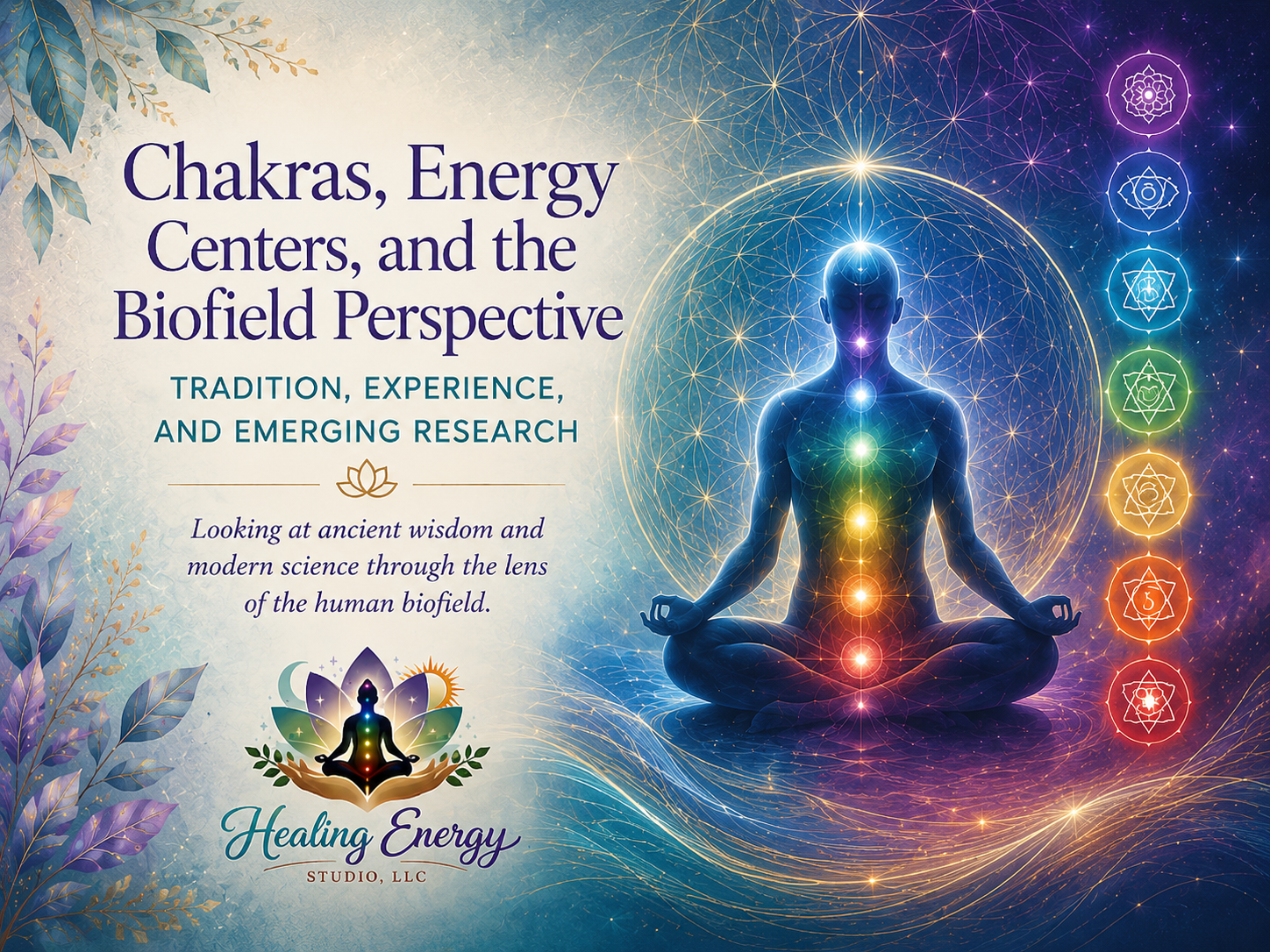
Chakras, Energy Centers, and the Biofield Perspective
Chakras come from ancient Indian spiritual traditions; the biofield is a modern research framework. They are not the same—but exploring both can open an interesting conversation about energy, experience, and the body.
Chakras are one of the most recognizable images in modern energy work: a series of centers running through the body, often shown in rainbow colors from root to crown.
But the history is much richer than that familiar diagram.
Chakras come from spiritual tradition
Chakra systems developed within Indian religious, philosophical, and yogic traditions. Different historical texts describe different numbers, meanings, symbols, and practices. The seven-chakra model common in Western wellness culture is one influential modern presentation—not the only chakra system that has ever existed.
Traditionally, chakras are part of a subtle-body framework rather than anatomical organs.
The biofield is a different concept
The modern term biofield is used in some scientific and integrative-health literature as a proposed framework for studying electromagnetic, biophotonic, and other spatially distributed aspects of living systems. One influential paper, Biofield Physiology, discusses measurable electrical and magnetic fields as well as more exploratory areas of research.
A biofield is not scientifically established as being the same thing as the chakra system. That distinction is important.
Why do people still find chakra language useful?
Because it gives people a map for paying attention.
The heart center can become a way to explore love, grief, boundaries, and connection. The throat can become a way to reflect on expression and truth. The root can become a way to think about safety, belonging, stability, and embodiment.
Whether someone understands those centers literally, symbolically, spiritually, or energetically, the framework can prompt meaningful self-observation.
Experience does not automatically equal anatomy
People may feel warmth, pressure, tingling, emotion, pulsing, openness, or heaviness in places commonly associated with chakras. Those experiences are real experiences.
What causes them may vary. Attention, breathing, muscle tension, autonomic shifts, expectation, emotion, sensory processing, and personal spiritual interpretation may all play roles.
Two maps can coexist without being identical
Modern anatomy gives us one map of the human body. The nervous system gives us another. Traditional energy systems give us another. Psychology gives us another.
None of them needs to erase the others.
I use chakra language as part of a broader energy-healing framework because it can help people notice patterns and connect with their own experience. I also think it is important to respect where those ideas came from and to avoid claiming that modern science has confirmed more than it actually has.
Sources for curious readers
If the Body Produces Fields, What Might We Still Be Missing?
The human body produces measurable electrical and magnetic activity, and living cells even emit ultraweak light. What might these known fields tell us about the larger ways living systems communicate—and what might we still be missing?
Science asks: Can we measure it? Can we repeat it? Can we test competing explanations?
In the last few weeks, we have looked at the human biofield and at something even more concrete: bioelectricity.
We know the body uses electrical signaling. We know the heart and brain generate measurable electrical activity. We know living tissues produce magnetic fields associated with that electrical activity. We know cells maintain voltage across their membranes, and that electrical gradients help guide growth, repair, and organization.
So here is the next question I think is worth asking:
If the body already produces measurable fields, what else might we still be learning about the way a living system communicates?
That question does not require us to leap to conclusions. It simply asks us to notice that the human body is not an isolated collection of parts. It is a dynamic, communicating system.
WHAT WE CAN ALREADY MEASURE
Some biological fields are familiar enough that we barely think of them as “fields” anymore.
An ECG records electrical activity associated with the heart. An EEG records electrical activity produced by the brain. More specialized instruments can measure magnetic fields generated by cardiac and neural activity through magnetocardiography and magnetoencephalography.
They are not hypothetical.
The open question is how far that principle extends.
Are the fields we currently measure simply by-products of electrical activity? Do some of them also carry information? Could there be forms of biological communication that become visible only when we look at the whole system rather than isolated molecules?
Those are research questions—not settled answers.
THE BODY IS NOT ONLY CHEMISTRY
Modern medicine became extraordinarily powerful by understanding chemistry.
Hormones bind to receptors. Neurotransmitters cross synapses. Enzymes speed reactions. Genes are transcribed. Proteins are built.
But biological regulation does not happen through chemistry alone.
Mechanical forces matter. Electrical gradients matter. Timing matters. Spatial pattern matters. The geometry of tissues matters. The relationships between cells matter.
That framework is still debated, and not every proposed aspect of “biofield science” is established. But I find the underlying question valuable:
How much do we miss when we study a living system one molecule at a time?
FIELDS CAN ORGANIZE BEHAVIOR
This is where the idea becomes especially interesting.
In biology, fields are not always passive.
Endogenous electric fields can influence cell migration. Voltage patterns across tissues can help regulate development and regeneration. Neural electromagnetic activity is associated with synchronization and rhythmic activity.
In other words, a field can sometimes be part of the environment in which cells decide what to do.
That does not mean every field around the body is a healing field.
It means that “field-based regulation” is not inherently outside biology.
That is a meaningful distinction.
WHY WHOLE-SYSTEM QUESTIONS MATTER
A living body is full of feedback loops.
The nervous system affects the immune system. Hormones affect the brain. The brain affects heart rate. Breathing affects autonomic regulation. Emotional states can change muscle tension, breathing patterns, heart rate, and stress hormones.
None of those systems operates in isolation.
We are used to thinking about communication through nerves, blood, and chemical messengers. But research into bioelectricity and biological fields asks whether information can also be distributed spatially across tissues and systems.
That possibility is one reason the biofield concept continues to attract attention. Researchers have proposed it as a way to investigate how living organisms generate and respond to electromagnetic, biophotonic, and other spatially distributed phenomena.
Again, proposal is not proof.
But a useful scientific framework often begins by helping us ask better questions.
WHAT ABOUT BIOPHOTONS?
Living systems also emit extremely faint photons.
Ultraweak photon emission is measurable in humans and is linked to metabolic and oxidative processes.
That does not mean the light described in spiritual traditions has been scientifically identified.
Still, I find it fascinating that a living body is literally emitting light, even if the amount is far too small for our eyes to see.
It is a reminder that life is physically more active and dynamic than it appears from the outside.
When people throughout history described humans as luminous, radiant, or surrounded by energy, they were speaking from spiritual, philosophical, or experiential traditions.
Modern biophysics uses a very different language.
I do not think we need to force those descriptions to mean the same thing.
But I also do not think we need to forbid ourselves from wondering whether different traditions sometimes notice different layers of the same reality.
WHAT WE SHOULD NOT CLAIM
Curiosity becomes much more useful when we stay clear about what the evidence does and does not show.
The existence of measurable electrical, magnetic, or photonic activity does not prove Reiki. It does not prove chakras. It does not prove the aura. It does not prove that every intuitive sensation is an electromagnetic event.
Those are separate questions.
But the measurable activity does tell us that the body is electrically and electromagnetically active, that cells respond to electrical information, and that some biological processes are organized through spatial patterns that cannot be reduced to one chemical reaction.
That is already remarkable.
WHAT IF OUR INSTRUMENTS ARE PART OF THE LIMIT?
Science can only measure what we have methods and instruments to detect.
That is not a criticism of science. It is simply how measurement works.
Before a phenomenon can be measured, someone has to imagine that it might exist, develop a method for observing it, and determine whether the observation is reliable.
Many things that are ordinary science today were once invisible.
That does not mean every invisible thing is real.
It means invisibility is not, by itself, a final argument.
This is where I think spirituality and science can sit together comfortably.
Science asks: Can we measure it? Can we repeat it? Can we test competing explanations?
Spirituality may ask: What do we experience? What has meaning? What feels true in the deepest parts of human life, even before we can explain it?
Those are not identical questions.
They also do not have to be enemies.
THE QUESTION I WANT TO KEEP OPEN
If the body produces electrical signals, magnetic fields, ultraweak photons, chemical gradients, mechanical forces, and complex patterns of information exchange, what does it actually mean to be a living system?
And how much of that system do we currently understand?
I do not think the most interesting answer is “science has proven energy healing.” It has not.
I also do not think the most interesting answer is “if science has not explained it yet, it cannot exist.” That closes the conversation too early.
The more interesting place is in between.
We know enough to understand that the body is dynamic, electrical, responsive, and profoundly interconnected.
We know enough to see that biological organization is more complex than a list of body parts.
And we know enough to recognize how much remains unanswered.
That is exactly where curiosity belongs.
SOURCES FOR CURIOUS READERS
The Human Biofield: What Science Is Beginning to Ask About Living Systems
The human body is electrical, produces measurable electromagnetic activity, and even emits extremely faint light. Could these discoveries tell us something about the “energy” spiritual traditions have described for centuries? Explore the emerging science of the human biofield—and the mystery that still remains.
Most of us were taught to think about the human body in terms of anatomy and chemistry.
Bones. Muscles. Organs. Hormones. Neurotransmitters. Blood. DNA.
All of those are real and important.
But living systems also generate and respond to electrical, magnetic, and even extremely faint light-based activity. That does not automatically prove the existence of an aura, chakras, Reiki energy, or any particular spiritual model. But it does raise a fascinating question:
Is there more happening in and around a living body than our traditional biochemical model describes?
Researchers have been asking versions of that question for decades.
One term that has emerged from that conversation is biofield.
WHERE DID THE WORD “BIOFIELD” COME FROM?
The word sounds very modern, but the idea behind it is much older.
Cultures around the world have long described life in terms of an organizing or animating force—qi, prana, ki, vital force, life force, breath, spirit.
The scientific term biofield entered the modern research conversation in the early 1990s. A historical review published in Global Advances in Health and Medicine describes the biofield concept as an attempt to create a framework for studying biological regulation and some of the phenomena historically associated with energy medicine. [Rubik et al., 2015]
That does not mean science declared an invisible healing field to be proven.
It means researchers needed language for asking questions that did not fit neatly inside a purely chemical description of the body.
That distinction matters.
Science often begins by creating a way to describe something before it fully understands it.
WHAT DO RESEARCHERS MEAN BY “BIOFIELD”?
There is not one universally settled definition.
One group of researchers proposed biofield physiology as an umbrella term for electromagnetic, biophotonic, and other spatially distributed fields that living organisms generate and respond to as part of cellular, tissue, and whole-body regulation. [Hammerschlag et al., 2015]
That is much broader than saying, “Scientists discovered the aura.”
They did not.
Instead, the biofield concept asks whether biological organization may involve communication and regulation occurring across multiple levels—and whether field-like processes deserve more investigation.
That question interests me because it sits right at the place where science and ancient healing traditions begin to look at one another.
Not necessarily agreeing.
But perhaps noticing some of the same mystery from very different directions.
WE ALREADY KNOW THE BODY IS ELECTRICALLY ACTIVE
There is nothing controversial about saying that the human body has measurable electrical activity.
Your heart depends on coordinated electrical signaling.
Your nervous system depends on electrical impulses.
Living cells maintain electrical differences across their membranes.
Those electrical processes also produce associated magnetic fields.
Modern medicine routinely measures some of this activity through technologies such as ECG and EEG.
So a living person is not merely a collection of chemicals.
We are electrochemical organisms.
The more interesting question begins when we ask whether those known electrical and electromagnetic processes account for everything practitioners and spiritual traditions describe as energy—or whether they represent only one measurable part of something larger.
At this point, science does not have a definitive answer.
LIVING CELLS ALSO EMIT LIGHT
Here is one of the more fascinating pieces of established biology.
Living systems emit extremely small amounts of light.
Researchers usually call this ultraweak photon emission, or UPE. A 2019 review of human UPE describes it as a measurable, visually undetectable phenomenon influenced by internal and external factors, including oxidative processes and physiological state. [Calcerrada & Garcia-Ruiz, 2019]
A 2024 review describes UPE as photons produced at extremely low intensities, largely as by-products of cellular metabolism, and notes that improved technology is making these emissions easier to detect and study. [Mould et al., 2024]
Human skin has also been directly imaged for ultraweak photon emission, with changes observed under oxidative stress such as ultraviolet exposure. [Ou-Yang et al., 2019]
Does that mean science has discovered the spiritual light people have described for centuries?
No.
But I still think it is remarkable.
Human beings used the language of light, radiance, energy, and life force long before we had equipment capable of detecting photons emitted by living tissue.
Maybe those ideas are unrelated.
Maybe some ancient descriptions were symbolic.
Maybe people were describing subjective spiritual experiences rather than physical light.
Or perhaps some traditional observations will eventually intersect with biology in ways we have not yet imagined.
We do not have to decide prematurely.
THIS IS WHERE CURIOSITY MATTERS
There is a tendency to approach questions like this from one of two extremes.
One side may say:
“If science cannot currently measure the energy used in Reiki, then it cannot exist.”
The other may say:
“Science has discovered electromagnetic fields and biophotons, therefore Reiki and chakras are scientifically proven.”
I do not find either position especially satisfying.
The first closes the door before the investigation is complete.
The second claims an answer that the research has not actually given us.
There is a much more interesting space between those two positions.
We can acknowledge what is already measurable.
We can respect what is still unknown.
And we can remain open to the possibility that our scientific model of life is still developing.
Because of course it is.
SCIENCE HAS CHANGED ITS MODEL OF THE BODY BEFORE
For much of medical history, people could observe biological effects without understanding their mechanisms.
Microorganisms existed before microscopes made them visible.
Genes affected inheritance long before DNA was understood.
The nervous system changed with experience long before modern neuroscience developed the language we now use for neuroplasticity.
None of that means every unexplained spiritual idea will eventually become established science.
It simply means:
“We cannot currently explain it” and “it cannot be real” are not the same statement.
That difference leaves room for investigation.
And for wonder.
IS THE BIOFIELD THE SAME AS THE AURA?
This is one of the questions people naturally ask.
The most accurate answer is:
We do not know that they are the same thing.
The aura is generally a spiritual or energetic concept describing a field or layers of energy surrounding a person.
The biofield is a research framework intended to investigate field-based aspects of living systems.
There are obvious conceptual similarities.
But using one word does not scientifically validate everything associated with the other.
Personally, I do not need them to be proven identical in order to find the comparison meaningful.
Spiritual traditions developed their language through observation, intuition, embodied experience, and spiritual practice.
Science develops its language through measurement, experimentation, and repeatability.
Those methods are different.
Sometimes they may eventually describe overlapping parts of the same reality.
Sometimes they may not.
WHY THIS MATTERS FOR ENERGY HEALING
When I practice Reiki or other forms of energy work, I am working from a model that says we are more than just our physical structure.
That does not require me to reject biology.
Quite the opposite.
The deeper I look into biology, neuroscience, consciousness, the nervous system, electrical signaling, and emerging biofield research, the more extraordinary the human body becomes.
Energy work does not have to compete with medicine.
Spiritual experience does not have to compete with science.
They can ask different questions.
Medicine may ask:
What disease process is occurring, and how do we treat it?
Biofield research may ask:
How do living systems organize and regulate themselves through forms of information and energy?
Energy healing may ask:
What happens when we intentionally support balance within the whole person?
Spirituality may ask:
Is there an aspect of life that extends beyond what we currently know how to measure?
I think all four questions are worth asking.
WHAT WE KNOW, WHAT WE WONDER
We know that living bodies are electrically active.
We know that biological electromagnetic activity exists.
We know that living cells emit ultraweak photons. [Calcerrada & Garcia-Ruiz, 2019]
We know that researchers have proposed the biofield as a framework for investigating aspects of biological organization that may not fit neatly within a purely biochemical model. [Rubik et al., 2015]
We do not yet know whether these measurable phenomena explain Reiki, chakras, auras, qi, prana, intuitive healing, or the many other experiences people have described throughout human history.
And that is okay.
Mystery is not failure.
Sometimes mystery is simply the place where the next question begins.
For me, that is one of the most exciting places where science and spirituality meet.
SOURCES FOR CURIOUS READERS
Rubik B, Muehsam D, Hammerschlag R, Jain S. Biofield Science and Healing: History, Terminology, and Concepts. Global Advances in Health and Medicine. 2015.
Hammerschlag R, Levin M, McCraty R, et al. Biofield Physiology: A Framework for an Emerging Discipline. Global Advances in Health and Medicine. 2015.
Calcerrada M, Garcia-Ruiz C. Human Ultraweak Photon Emission: Key Analytical Aspects, Results and Future Trends—A Review. Critical Reviews in Analytical Chemistry. 2019.
Mould RR, et al. Ultra Weak Photon Emission—A Brief Review. Frontiers in Physiology. 2024.
What Is Energy Healing, Really?
Energy healing has roots in traditions that long predate modern medicine, but science is now asking its own questions about biofields, electrical signaling, and the complex ways living systems communicate. Explore what we know, what traditions have taught, and what remains beautifully unexplained.
A Bridge Between Ancient Wisdom and Modern Inquiry
For most of human history, people have understood the body as more than simply a collection of organs, muscles, bones, and chemicals.
Different cultures developed different words for something that seemed to animate living beings: qi in Chinese traditions, prana in Indian traditions, ki in Japan, and other concepts of breath, spirit, vitality, or life force throughout the world.
Today, people who practice Reiki and other forms of energy healing may use words such as energy, life-force energy, subtle energy, biofield, vibration, frequency, or energetic balance.
Those words can sound strange if your only exposure to healing has been through conventional Western medicine.
But here is where the conversation becomes interesting.
Modern science also recognizes that the human body is not simply chemical. We are electrical. We generate measurable electromagnetic activity. Cells communicate through electrical as well as chemical processes. Our brains and hearts create signals strong enough to be measured outside the cells producing them.
None of that proves every traditional belief about energy.
But it does make the conversation about human energy much more interesting than simply dismissing it as “woo-woo.”
So What Is Energy Healing?
At its simplest, energy healing is based on the idea that the human being has an energetic component and that supporting balance within that system may support the whole person.
Different modalities approach this in different ways.
Reiki practitioners traditionally work with universal life-force energy. Healing Touch and Therapeutic Touch developed somewhat differently but also work from the idea of interacting with a person's energetic field. Qigong includes practices designed to cultivate and regulate qi. Other traditions work with chakras, meridians, breath, prayer, intention, sound, movement, or touch.
These traditions do not all mean exactly the same thing by “energy.”
That is important.
We sometimes try to take spiritual concepts developed over thousands of years and force them into a single modern scientific definition. They may overlap, but they do not necessarily describe the same phenomenon.
Science has developed its own language.
Researchers studying practices such as Reiki, Healing Touch, and Therapeutic Touch commonly use the term biofield therapies. A major review published in the International Journal of Behavioral Medicine described Reiki, Therapeutic Touch, and Healing Touch within this category and reviewed 66 clinical studies involving biofield therapies. The review reported promising findings in some areas—particularly pain—and more mixed evidence in others, while also emphasizing the need for stronger research.
The important point is not that science has solved the mystery.
It hasn't.
The important point is that people are studying it.
What Is a Biofield?
This is where the scientific and spiritual conversations begin moving closer together.
A group of researchers writing about biofield physiology proposed the biofield as a framework for studying spatially distributed fields that living systems generate and respond to.
Their discussion included things we already know exist, such as the electrical and magnetic activity produced by the heart and nervous system, along with less-understood phenomena such as ultraweak photon emissions from living cells.
We routinely measure some of these biological signals.
An ECG measures electrical activity associated with the heart.
An EEG measures electrical activity in the brain.
Magnetocardiography and magnetoencephalography can detect magnetic fields associated with cardiac and neural activity.
Researchers also study electrical patterns involved in development, cellular organization, tissue injury, and regeneration.
So when someone says, “The body has energy,” that statement is not inherently unscientific.
The much harder question is:
Does the measurable electrical and electromagnetic activity of the body explain what energy healers experience and work with?
We don't know.
And I think we don't know is an incredibly interesting place to begin.
Science and Spirituality Ask Different Questions
Science is designed to observe, measure, test, reproduce, and challenge ideas.
That has given humanity extraordinary knowledge.
But science can only investigate something once we have a way to observe or measure it.
That limitation does not make science inadequate. It simply means that scientific knowledge evolves alongside our ability to ask better questions and develop better tools.
Spirituality approaches life differently.
Spirituality allows us to experience something before we can explain it.
Love existed before we could watch parts of the brain respond to attachment.
Meditation existed thousands of years before researchers began measuring its effects on the nervous system and brain.
Human beings practiced breathing techniques, prayer, laying on of hands, fasting, movement, herbs, and other healing traditions long before laboratories existed.
Some traditional beliefs eventually find scientific explanations.
Some turn out to have been misunderstood.
Some remain mysteries.
I don't think we have to choose between those possibilities.
The Body May Be More Complex Than One Model Can Explain
One of the things I find fascinating about modern medicine is how much our understanding of the body continues to expand.
For a long time, biology was largely explained through chemistry: hormones, neurotransmitters, proteins, enzymes, DNA.
All of those things remain enormously important.
But researchers now also study bioelectric signaling, electromagnetic activity, psychoneuroimmunology, epigenetics, interoception, neuroplasticity, the microbiome, mind-body interactions, and many other systems that would have sounded very different in medical conversations generations ago.
Researchers have even proposed “biofield science” as an emerging discipline for investigating biological organization beyond purely molecular explanations.
That does not mean every proposed explanation is correct.
It means the conversation is still happening.
And that is exactly where curiosity belongs.
What About Reiki?
Reiki is one form of energy work, and it is the modality I use most frequently in my own practice.
During Reiki, a practitioner generally places their hands lightly on the body or holds them just above it with the intention of supporting the recipient's natural healing response.
The National Center for Complementary and Integrative Health describes Reiki as a complementary health approach based on the concept of energy supporting the body's natural healing abilities. NCCIH also notes that research results remain inconsistent and that the proposed Reiki energy itself has not been scientifically demonstrated.
I am comfortable holding both parts of that statement.
Science has not fully explained Reiki.
And Reiki has been experienced and practiced by people around the world regardless of whether we currently understand its mechanism.
Those ideas can coexist.
Experience Matters Too
This is one of the places where I differ from the idea that something has no value until science can explain exactly how it works.
Research matters.
Evidence matters.
Critical thinking matters.
But human experience matters too.
When someone lies on my Reiki table and feels warmth where my hands are not touching them, that experience matters to them.
When someone becomes deeply relaxed after arriving tense and overwhelmed, that matters.
When someone experiences an emotional release they did not anticipate, that matters.
It does not automatically tell us why it happened.
And it certainly doesn't mean that every sensation must have a supernatural explanation.
But curiosity allows us to ask the question instead of immediately dismissing the experience.
Maybe some of what happens during energy work involves the nervous system.
Maybe attention and intention matter.
Maybe the therapeutic environment matters.
Maybe expectation plays a role.
Maybe biological fields are involved.
Maybe consciousness itself has aspects we do not yet understand.
Maybe more than one of those things is true.
We Don't Have to Choose a Side
This series is going to explore that space.
We will look at Reiki research, biofields, nervous-system regulation, chakras, qi and prana, meditation, consciousness, epigenetics, intuition, healing traditions, hospital programs, oncology, prayer, the work of people such as Bruce Lipton, Joe Dispenza, and Sue Morter, and some of the questions science has not yet answered.
I am not interested in using science to prove spirituality.
And I am not interested in rejecting science because it cannot yet explain every spiritual experience.
I am interested in the bridge between them.
Because perhaps one of the most valuable things we can say about healing is:
There is a great deal we know. There is a great deal we are beginning to understand. And there is still a great deal that remains beautifully mysterious.
That feels like a very good place to begin.
A Few Sources for Curious Readers
Jain S, Mills PJ. Biofield therapies: helpful or full of hype? A best evidence synthesis. International Journal of Behavioral Medicine. The review evaluated 66 clinical studies of several biofield therapies and reported evidence ranging from promising to inconclusive depending on the outcome studied.
Hammerschlag R, Levin M, McCraty R, et al. Biofield Physiology: A Framework for an Emerging Discipline. The paper explores biological electromagnetic activity, bioelectric signaling, ultraweak photon emission, and the possibility of a broader biofield physiology framework.
Rubik B, Muehsam D, Hammerschlag R, Jain S. Biofield Science and Healing: History, Terminology, and Concepts. This paper examines the history and terminology of biofield concepts and their relationship to energy medicine.
The National Center for Complementary and Integrative Health also maintains an overview of Reiki and the current state of conventional scientific evidence.