

DNA, Energy, and Information: Beyond the Double Helix
DNA is not a mystical blueprint that determines everything about us. Explore gene regulation, epigenetics, cellular energy, and emerging research on ultraweak photon emission without turning science into mythology.
DNA may be one of the most misunderstood symbols in wellness culture.
We often hear phrases like “your genes are your destiny” on one side and “you can change your DNA with your thoughts” on the other.
Biology is much more interesting than either extreme.
DNA stores information—but genes are regulated
Your DNA sequence contains genetic information, but cells constantly regulate which genes are active, when they are active, and how strongly they are expressed.
Epigenetics is one part of that regulation. Chemical modifications to DNA and associated proteins, along with noncoding RNAs and other mechanisms, can influence gene expression without changing the underlying DNA sequence.
A 2026 review of environmental epigenetics describes epigenetic processes as an important interface between genetic predisposition and lifelong environmental influences. A 2025 review of stress and epigenetic regulation discusses ways stress can influence DNA methylation, histone modifications, and noncoding RNA.
This does not mean thoughts simply rewrite your genetic code
Environment and experience can influence biology, but that is not the same as saying every belief directly edits DNA on command.
Epigenetics is complex, tissue-specific, and shaped by many interacting factors. I still find the larger message powerful: genes are important, but biology is dynamic.
Where does “energy” enter the conversation?
Cells require energy to maintain gradients, build molecules, repair damage, communicate, and stay alive. Living systems are chemical and electrical at the same time.
There is also emerging work on ultraweak photon emission—extremely faint light produced by biological processes. A 2024 review summarizes research on these emissions and their relationship to cellular metabolism and oxidative processes.
A provocative 2024 study reported ultraweak photon emission from isolated DNA under specific experimental conditions. It is an intriguing finding, not proof that DNA is a spiritual antenna or that thoughts communicate with genes through light.
Information is one of biology’s biggest themes
DNA stores sequence information. Cells communicate through molecules, voltage, mechanical forces, and timing. Tissues coordinate across distances. Organisms continually sense and respond to their environments.
That language—signal, message, pattern, memory, regulation—can sound surprisingly close to the language used in energy work. But similarity in language is not proof that the mechanisms are the same.
The more we learn, the more interesting life becomes
I do not need to exaggerate science to find it extraordinary.
DNA is not a static fate. Cells are not passive containers. The body is continuously exchanging energy and information at many levels.
And there is still an enormous amount we do not understand about how all of those levels become one coherent living person.
Sources for curious readers
Environmental Epigenetics: New Horizons in Redefining Biological and Health Outcomes
Epigenetic Regulation of Stress
The Nervous System as an Energy System: Regulation, Safety, and Healing
Your nervous system communicates through electrical and chemical signals and constantly adjusts to the world around you. Explore why regulation and felt safety matter so much in healing work.
The nervous system is one of the clearest examples of energy and information moving through the body.
Neurons communicate through electrochemical signals. Nerves carry information between brain, spinal cord, organs, muscles, and sensory systems. Your autonomic nervous system continually adjusts heart rate, breathing, digestion, blood-vessel tone, and many other functions.
Your nervous system is always listening
It is monitoring both the outside world and your internal state. A sound, memory, facial expression, physical sensation, conflict, pain, or sense of connection can shift your state before you have consciously decided anything.
A major review of the stress response and the extended autonomic system describes the deep integration of autonomic, hormonal, immune, and brain systems in maintaining homeostasis and responding to stress.
Why safety matters
“Safety” does not mean pretending everything is okay. It means the body has enough signals of support that it does not have to devote every resource to defense.
This is one reason a quiet environment, grounded practitioner, predictable touch, permission, boundaries, and choice can matter during healing work.
Energy work can begin with regulation
I do not see nervous-system work and energy work as competitors. They can support one another.
Grounding, slow breathing, gentle attention to the body, and quiet Reiki can create conditions in which a person has a chance to soften. That does not prove a particular energetic mechanism. It simply recognizes something very practical: a regulated system has more room for awareness.
The body is electrical—but energy language is broader
The nervous system’s electrical activity is measurable science. When someone says, “My energy feels calmer,” they may be describing a larger subjective experience that includes nervous-system state, emotion, attention, meaning, and perhaps something they understand spiritually.
We do not have to force all of those layers into one explanation.
Sometimes healing starts not with doing more, but with helping the body realize it no longer has to fight the entire world at once.
Sources for curious readers
Energy Flow and Regulation: How Living Systems Find Their Way Back Toward Balance
The body is constantly adjusting to keep us functioning through change. Explore homeostasis, allostasis, regulation, and why balance is better understood as movement than stillness.
When we use the word balance, it can sound as though the goal is to reach one perfect state and stay there. Living systems do not work that way.
Your body is adjusting constantly—temperature, blood pressure, blood sugar, breathing, hormones, hydration, attention, immune activity, sleep, and thousands of other processes are continually responding to what is happening inside and around you.
Balance is active, not static
Homeostasis is the familiar biological idea that the body regulates internal conditions within workable ranges. Modern physiology also uses the concept of allostasis: maintaining stability through change and adaptation.
A review comparing homeostasis and allostasis describes them as related ways of understanding physiological regulation. Bruce McEwen’s foundational work on allostasis and allostatic load helped explain how repeated or prolonged adaptation can create wear and tear when stress systems stay activated too often or too long.
This changes how I think about “energy flow”
In energy work, we often talk about flow, balance, congestion, depletion, and restoration. Science does not define those terms the way an energy practitioner does, but living biology itself is full of movement and feedback.
Healthy function is not stillness. It is responsiveness.
Regulation is not the same as control
Trying to control every sensation or emotion can create more tension. Regulation is different. It is the capacity to stay in relationship with what is happening without being completely overwhelmed by it.
Sometimes regulation looks like rest. Sometimes it looks like movement. Sometimes it looks like crying, breathing, talking, praying, sleeping, receiving Reiki, sitting quietly, or finally setting a boundary.
Why healing often feels like movement
People sometimes expect healing to feel immediately peaceful. But reorganization can feel like movement first: emotion rising, warmth shifting, muscles releasing, breath deepening, fatigue surfacing, or a new awareness becoming impossible to ignore.
I like the idea that balance is not a frozen destination. It is the ability to keep finding our way back toward ourselves.
Sources for curious readers
Clarifying the Roles of Homeostasis and Allostasis in Physiological Regulation
Stress, Adaptation, and Disease: Allostasis and Allostatic Load
Energy and the Stress Response: What Happens When Your Body Stays on Alert
Stress is not just a thought—it is a whole-body response. Learn how the nervous system, hormones, breathing, tension, and energy can change when the body stays on alert.
Have you ever had a day when you technically did not do that much, but you ended it completely exhausted?
That is one of the clearest reminders that energy is not only about physical activity. Stress can consume enormous internal resources.
Stress is a whole-body event
When your brain perceives a challenge or threat, the body can activate a coordinated stress response. Heart rate and breathing may increase. Muscles may tense. Attention narrows. Stress hormones help mobilize energy for action.
The National Center for Complementary and Integrative Health describes stress as both a physical and emotional reaction and notes that chronic stress can contribute to or worsen a range of health problems.
A broad review of stress and health describes effects involving the autonomic nervous system, the HPA axis, cortisol dynamics, behavior, and gene expression.
Why stress can feel like an energy problem
When people say, “I feel drained,” “I feel wired,” “I cannot settle,” or “my energy feels scattered,” those words may be describing several layers at once: physiology, emotion, sleep, grief, uncertainty, and the energetic experience of feeling ungrounded or depleted.
Your body is built to respond—and to recover
The stress response itself is protective. The difficulty comes when the body repeatedly activates without enough opportunity to settle afterward.
Regulation does not mean never feeling stressed. It means having enough flexibility to move into activation when needed and then move back toward rest, digestion, connection, and recovery.
Why slowing down can change so much
Slow breathing, quiet attention, meditation, gentle movement, prayer, time in nature, Reiki, and other calming practices may feel very different from one another, but they often have one thing in common: they interrupt the constant demand for action.
For some people, the first noticeable change is physical—the jaw softens or breathing deepens. For others it is emotional. For others, the shift is described energetically: “I feel like I came back into my body.”
Energy work does not require ignoring the nervous system
In my work, I see the nervous system and energy as complementary ways of understanding the whole person. If someone is overwhelmed, grounding matters. Safety matters. Breath matters. Rest matters.
Healing is not always about pushing the body to do more. Sometimes it begins by giving the body enough space to stop bracing.
Sources for curious readers
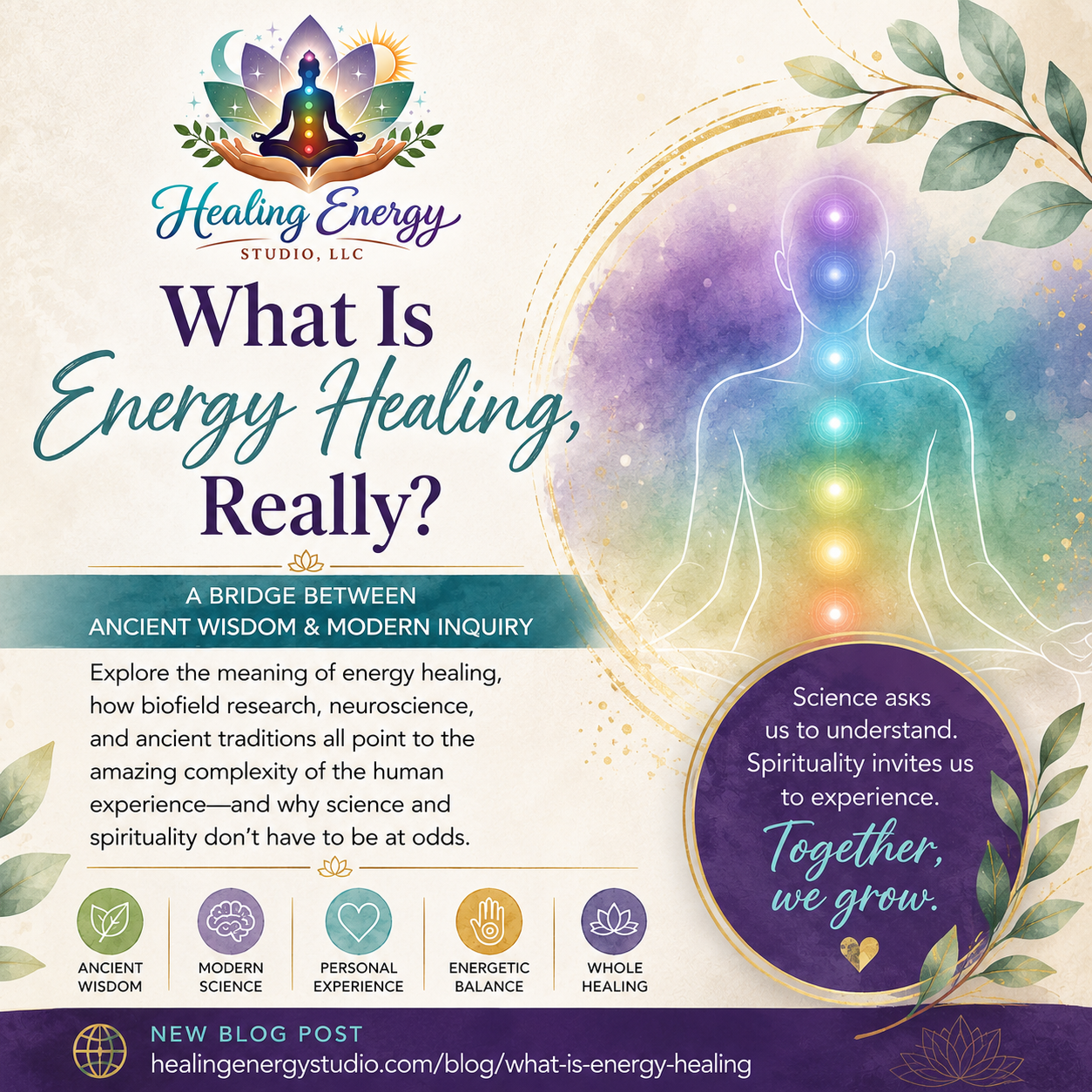
What Is Energy Healing, Really?
Energy healing has roots in traditions that long predate modern medicine, but science is now asking its own questions about biofields, electrical signaling, and the complex ways living systems communicate. Explore what we know, what traditions have taught, and what remains beautifully unexplained.
A Bridge Between Ancient Wisdom and Modern Inquiry
For most of human history, people have understood the body as more than simply a collection of organs, muscles, bones, and chemicals.
Different cultures developed different words for something that seemed to animate living beings: qi in Chinese traditions, prana in Indian traditions, ki in Japan, and other concepts of breath, spirit, vitality, or life force throughout the world.
Today, people who practice Reiki and other forms of energy healing may use words such as energy, life-force energy, subtle energy, biofield, vibration, frequency, or energetic balance.
Those words can sound strange if your only exposure to healing has been through conventional Western medicine.
But here is where the conversation becomes interesting.
Modern science also recognizes that the human body is not simply chemical. We are electrical. We generate measurable electromagnetic activity. Cells communicate through electrical as well as chemical processes. Our brains and hearts create signals strong enough to be measured outside the cells producing them.
None of that proves every traditional belief about energy.
But it does make the conversation about human energy much more interesting than simply dismissing it as “woo-woo.”
So What Is Energy Healing?
At its simplest, energy healing is based on the idea that the human being has an energetic component and that supporting balance within that system may support the whole person.
Different modalities approach this in different ways.
Reiki practitioners traditionally work with universal life-force energy. Healing Touch and Therapeutic Touch developed somewhat differently but also work from the idea of interacting with a person's energetic field. Qigong includes practices designed to cultivate and regulate qi. Other traditions work with chakras, meridians, breath, prayer, intention, sound, movement, or touch.
These traditions do not all mean exactly the same thing by “energy.”
That is important.
We sometimes try to take spiritual concepts developed over thousands of years and force them into a single modern scientific definition. They may overlap, but they do not necessarily describe the same phenomenon.
Science has developed its own language.
Researchers studying practices such as Reiki, Healing Touch, and Therapeutic Touch commonly use the term biofield therapies. A major review published in the International Journal of Behavioral Medicine described Reiki, Therapeutic Touch, and Healing Touch within this category and reviewed 66 clinical studies involving biofield therapies. The review reported promising findings in some areas—particularly pain—and more mixed evidence in others, while also emphasizing the need for stronger research.
The important point is not that science has solved the mystery.
It hasn't.
The important point is that people are studying it.
What Is a Biofield?
This is where the scientific and spiritual conversations begin moving closer together.
A group of researchers writing about biofield physiology proposed the biofield as a framework for studying spatially distributed fields that living systems generate and respond to.
Their discussion included things we already know exist, such as the electrical and magnetic activity produced by the heart and nervous system, along with less-understood phenomena such as ultraweak photon emissions from living cells.
We routinely measure some of these biological signals.
An ECG measures electrical activity associated with the heart.
An EEG measures electrical activity in the brain.
Magnetocardiography and magnetoencephalography can detect magnetic fields associated with cardiac and neural activity.
Researchers also study electrical patterns involved in development, cellular organization, tissue injury, and regeneration.
So when someone says, “The body has energy,” that statement is not inherently unscientific.
The much harder question is:
Does the measurable electrical and electromagnetic activity of the body explain what energy healers experience and work with?
We don't know.
And I think we don't know is an incredibly interesting place to begin.
Science and Spirituality Ask Different Questions
Science is designed to observe, measure, test, reproduce, and challenge ideas.
That has given humanity extraordinary knowledge.
But science can only investigate something once we have a way to observe or measure it.
That limitation does not make science inadequate. It simply means that scientific knowledge evolves alongside our ability to ask better questions and develop better tools.
Spirituality approaches life differently.
Spirituality allows us to experience something before we can explain it.
Love existed before we could watch parts of the brain respond to attachment.
Meditation existed thousands of years before researchers began measuring its effects on the nervous system and brain.
Human beings practiced breathing techniques, prayer, laying on of hands, fasting, movement, herbs, and other healing traditions long before laboratories existed.
Some traditional beliefs eventually find scientific explanations.
Some turn out to have been misunderstood.
Some remain mysteries.
I don't think we have to choose between those possibilities.
The Body May Be More Complex Than One Model Can Explain
One of the things I find fascinating about modern medicine is how much our understanding of the body continues to expand.
For a long time, biology was largely explained through chemistry: hormones, neurotransmitters, proteins, enzymes, DNA.
All of those things remain enormously important.
But researchers now also study bioelectric signaling, electromagnetic activity, psychoneuroimmunology, epigenetics, interoception, neuroplasticity, the microbiome, mind-body interactions, and many other systems that would have sounded very different in medical conversations generations ago.
Researchers have even proposed “biofield science” as an emerging discipline for investigating biological organization beyond purely molecular explanations.
That does not mean every proposed explanation is correct.
It means the conversation is still happening.
And that is exactly where curiosity belongs.
What About Reiki?
Reiki is one form of energy work, and it is the modality I use most frequently in my own practice.
During Reiki, a practitioner generally places their hands lightly on the body or holds them just above it with the intention of supporting the recipient's natural healing response.
The National Center for Complementary and Integrative Health describes Reiki as a complementary health approach based on the concept of energy supporting the body's natural healing abilities. NCCIH also notes that research results remain inconsistent and that the proposed Reiki energy itself has not been scientifically demonstrated.
I am comfortable holding both parts of that statement.
Science has not fully explained Reiki.
And Reiki has been experienced and practiced by people around the world regardless of whether we currently understand its mechanism.
Those ideas can coexist.
Experience Matters Too
This is one of the places where I differ from the idea that something has no value until science can explain exactly how it works.
Research matters.
Evidence matters.
Critical thinking matters.
But human experience matters too.
When someone lies on my Reiki table and feels warmth where my hands are not touching them, that experience matters to them.
When someone becomes deeply relaxed after arriving tense and overwhelmed, that matters.
When someone experiences an emotional release they did not anticipate, that matters.
It does not automatically tell us why it happened.
And it certainly doesn't mean that every sensation must have a supernatural explanation.
But curiosity allows us to ask the question instead of immediately dismissing the experience.
Maybe some of what happens during energy work involves the nervous system.
Maybe attention and intention matter.
Maybe the therapeutic environment matters.
Maybe expectation plays a role.
Maybe biological fields are involved.
Maybe consciousness itself has aspects we do not yet understand.
Maybe more than one of those things is true.
We Don't Have to Choose a Side
This series is going to explore that space.
We will look at Reiki research, biofields, nervous-system regulation, chakras, qi and prana, meditation, consciousness, epigenetics, intuition, healing traditions, hospital programs, oncology, prayer, the work of people such as Bruce Lipton, Joe Dispenza, and Sue Morter, and some of the questions science has not yet answered.
I am not interested in using science to prove spirituality.
And I am not interested in rejecting science because it cannot yet explain every spiritual experience.
I am interested in the bridge between them.
Because perhaps one of the most valuable things we can say about healing is:
There is a great deal we know. There is a great deal we are beginning to understand. And there is still a great deal that remains beautifully mysterious.
That feels like a very good place to begin.
A Few Sources for Curious Readers
Jain S, Mills PJ. Biofield therapies: helpful or full of hype? A best evidence synthesis. International Journal of Behavioral Medicine. The review evaluated 66 clinical studies of several biofield therapies and reported evidence ranging from promising to inconclusive depending on the outcome studied.
Hammerschlag R, Levin M, McCraty R, et al. Biofield Physiology: A Framework for an Emerging Discipline. The paper explores biological electromagnetic activity, bioelectric signaling, ultraweak photon emission, and the possibility of a broader biofield physiology framework.
Rubik B, Muehsam D, Hammerschlag R, Jain S. Biofield Science and Healing: History, Terminology, and Concepts. This paper examines the history and terminology of biofield concepts and their relationship to energy medicine.
The National Center for Complementary and Integrative Health also maintains an overview of Reiki and the current state of conventional scientific evidence.
The Heart Math Connection: Science, Coherence, and Emotional Energy
Your heartbeat is constantly changing in response to breath, emotion, movement, and stress. Explore heart-rate variability, coherence, and why the heart can be such a useful doorway into self-regulation.
The heart is one of the easiest places to feel the connection between our physical body and our emotional state.
Think about how quickly your heartbeat changes when you are frightened, excited, grieving, relieved, deeply relaxed, or suddenly surprised. Long before we measure anything, we can feel that our inner state and our heart are in conversation.
Heart rate variability: the rhythm inside the rhythm
Your heart does not beat like a metronome. The time between beats naturally changes from moment to moment. That variation is called heart rate variability, or HRV.
HRV is influenced by the autonomic nervous system—the part of the nervous system involved in functions such as heart rate, breathing, digestion, and the stress response. Researchers often use HRV as one window into autonomic regulation.
Practices that slow breathing and support relaxation can change heart-rhythm patterns. A 2024 systematic review and meta-analysis found small improvements in vagally mediated HRV from stress-management interventions in adults with cardiovascular disease, with biofeedback contributing to the observed effect.
What does “coherence” mean?
The HeartMath Institute uses the term heart coherence for a smoother, more ordered HRV pattern that can occur during paced breathing and certain emotional-focus practices. Their biofeedback tools measure heart-rhythm patterns and teach users to intentionally shift them. You can read HeartMath’s explanation of HRV coherence here.
I think this is interesting without needing to turn it into something it is not. HRV is measurable physiology. “Emotional energy” is a broader way many of us describe the felt experience of our emotional state. Those two languages do not have to be identical to be useful together.
The heart, the brain, and the nervous system
The heart and brain communicate constantly through neural, hormonal, circulatory, and other physiological pathways. When stress rises, heart rate, breathing, muscle tension, and stress hormones can all change. When we intentionally slow down, breathe, and feel safe enough to settle, the body can shift toward a different state.
This is one reason I often begin energy work with grounding and breathing. Before we talk about subtle energy at all, we are already giving the nervous system a different kind of input.
Where energy language fits for me
Many people experience emotional states as energy: heaviness in the chest, butterflies in the stomach, warmth around the heart, a rush through the body, or a sense of expansion when something finally releases.
Some of those sensations have straightforward physiological pieces. Others are more subjective and personal. I do not think we have to choose between them.
The body is measurable. Experience is real too. The heart is a beautiful example of a place where the two meet.
A simple practice: place a hand over your heart, let your breathing slow comfortably, and bring to mind one person, place, animal, memory, or moment that naturally creates a feeling of appreciation. Do not force a particular emotion. Just notice what happens in your breathing, chest, shoulders, and overall state.