

Qi, Prana, Life Force: Why So Many Cultures Developed a Language for Vital Energy
Qi, prana, ki, vital force—cultures around the world developed language for the animating quality of life. Explore what these traditions actually mean, where they overlap, and why they should not be reduced to modern scientific terms too quickly.
Across cultures that developed thousands of miles apart, people created language for something they experienced as vital, animating, and deeply connected with health and life.
In China, that language includes qi.
In India, prana.
In Japan, ki.
Other traditions have used terms such as vital force, breath of life, spirit, or life energy.
The words are not identical, and the traditions behind them should not be collapsed into one idea.
But the recurrence of these concepts across cultures raises a fascinating question:
Why did so many human traditions come to describe life as more than matter alone?
QI: MORE THAN A SIMPLE TRANSLATION
In Chinese philosophy and medicine, qi is a foundational concept.
It is often translated into English as “energy” or “life force,” but those translations can oversimplify the original meaning.
Qi has been used historically in ways that include breath, vitality, movement, transformation, material process, and the dynamic activity through which life and the natural world are organized.
That is worth remembering.
When we use the word energy in English, we may think immediately of electricity or physics.
Traditional qi language belongs to a different intellectual framework.
PRANA: BREATH, VITALITY, AND LIFE
Prana comes from Indian philosophical and yogic traditions.
It is often translated as vital energy, life force, or breath.
In yoga, prana is closely connected with breathing, but it is not limited to oxygen or the mechanical act of respiration.
Traditional yogic teachings describe prana as a subtle life-sustaining principle that moves through the body and is influenced by breath, attention, posture, and practice.
Pranayama—the yogic discipline of working with breath—is named from the same root.
That research does not prove prana as a measurable physical substance.
It does show that the experience and language of prana remain meaningful enough to study systematically.
KI: THE JAPANESE LANGUAGE OF VITAL ENERGY
The “ki” in Reiki is related linguistically and culturally to the Chinese concept of qi.
Japanese culture uses the character in many words connected with mood, vitality, atmosphere, spirit, and condition.
In Reiki, ki is commonly explained as life energy or vital energy.
That is one reason Reiki is often translated as “universal life energy.”
Again, translation gives us a useful doorway, but not a perfect equivalence.
The concept carries cultural meaning that is difficult to fit neatly into one English word.
WHY BREATH APPEARS SO OFTEN
One of the most interesting patterns across traditions is the connection between life energy and breath.
That makes intuitive sense.
Breathing is one of the clearest signs of life.
Breath changes with emotion.
Breath changes with exertion.
Breath changes with fear, rest, sleep, grief, prayer, meditation, and pain.
And unlike most physiological processes, breathing sits in a unique place between voluntary and automatic control.
We breathe without thinking about it, but we can also intentionally change how we breathe.
Ancient traditions may not have used modern language about autonomic regulation, carbon dioxide, vagal signaling, or respiratory chemistry.
But they had direct access to the experience of breath and its effects on state.
That alone may help explain why breath became one of humanity’s oldest bridges between body and spirit.
ARE QI, PRANA, AND BIOELECTRICITY THE SAME THING?
No one can responsibly say that they are.
Bioelectricity refers to measurable electrical properties of living cells and tissues.
Qi and prana come from traditional philosophical and healing systems with much broader meanings.
It is tempting to translate ancient concepts directly into modern physiology, but doing so can flatten both sides.
The fact that cells have membrane potentials does not prove qi.
The fact that the heart generates an electromagnetic field does not prove prana.
The fact that Reiki uses the word ki does not mean Reiki energy has been identified as a known electromagnetic phenomenon.
Those distinctions matter.
But distinction does not mean the traditions have nothing to say to one another.
A QUESTION OF LANGUAGE
Imagine two people standing beside the same river.
One describes water temperature, flow rate, mineral content, and pressure.
The other describes the river as cleansing, powerful, sacred, alive, or emotionally meaningful.
Are they talking about the same river?
Yes.
Are they saying the same thing?
No.
One language does not automatically replace the other.
Traditional energy systems and modern physiology may sometimes work like that.
Science asks for measurable mechanisms.
Traditional systems often describe patterns of lived experience, balance, relationship, movement, and meaning.
Some concepts may eventually overlap with measurable biology.
Others may remain symbolic, experiential, philosophical, or spiritual.
We do not have to force every word into a laboratory category in order to learn from it.
WHY SO MANY CULTURES NOTICED “VITALITY”
Human beings have always been able to observe the difference between a living body and a dead one.
The structure may still be present, but something unmistakable has changed.
Breath stops.
Warmth changes.
Movement ceases.
Responsiveness disappears.
Presence feels different.
Long before physiology could describe ATP, ion gradients, metabolism, neural firing, circulation, or oxygen exchange, people needed language for the quality that seemed to animate life.
It is not surprising that cultures created concepts of vitality.
What is remarkable is how persistent those concepts have been.
Western history has its own versions: vitalism, vital force, animal magnetism, and other theories attempted to explain what made living systems different from nonliving matter.
Many of those historical theories were later replaced or revised as biology developed.
But the deeper question—what makes a living system organized, responsive, self-repairing, and conscious—has not disappeared.
SCIENCE HAS EXPLAINED MUCH, BUT NOT EVERYTHING
Modern biology has explained an extraordinary amount about how life functions.
We know about cellular respiration, genetics, metabolism, electrophysiology, signaling pathways, immune responses, and development.
We can measure many processes ancient healers could only observe indirectly.
But explaining mechanisms does not necessarily exhaust the human experience of being alive.
Consciousness remains mysterious.
The way meaning changes physiology is still being studied.
The body’s ability to organize itself across billions of cells continues to reveal new layers of complexity.
So I do not see ancient energy concepts as competitors to science.
I see them as part of humanity’s long attempt to describe life.
Some of those descriptions may eventually map onto measurable physiology.
Some may not.
Some may have value precisely because they describe experience rather than mechanism.
THE VALUE OF NOT RUSHING THE TRANSLATION
There is a temptation in wellness spaces to say, “Qi is electricity,” or “prana is the biofield,” or “ancient people already knew quantum physics.”
I do not think we need those claims.
They make the conversation smaller, not bigger.
Ancient traditions deserve to be understood on their own terms.
Science deserves to be represented accurately.
And mystery deserves to remain mystery when we do not yet know.
The more interesting question is not, “Which ancient word is secretly the modern scientific term?”
The more interesting question is:
What were people noticing that led them, again and again, to describe life as movement, breath, vitality, flow, and connection?
That question can stay open.
And I think there is wisdom in leaving it open long enough to really listen.
SOURCES FOR CURIOUS READERS
Kim M. Understanding Qi: Its Development and Clinical Application to Nursing Practices. 2008.
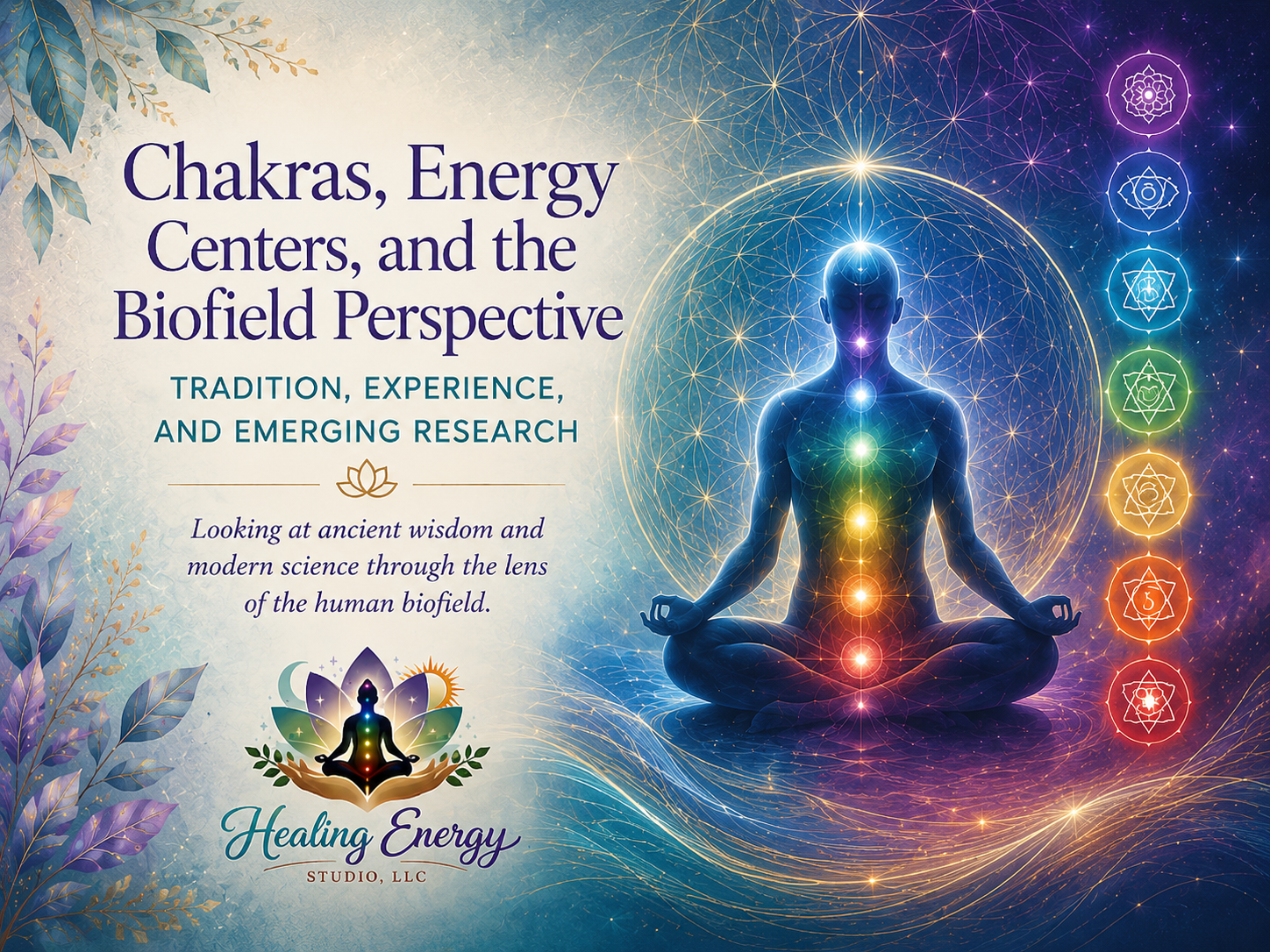
Chakras, Energy Centers, and the Biofield Perspective
Chakras come from ancient Indian spiritual traditions; the biofield is a modern research framework. They are not the same—but exploring both can open an interesting conversation about energy, experience, and the body.
Chakras are one of the most recognizable images in modern energy work: a series of centers running through the body, often shown in rainbow colors from root to crown.
But the history is much richer than that familiar diagram.
Chakras come from spiritual tradition
Chakra systems developed within Indian religious, philosophical, and yogic traditions. Different historical texts describe different numbers, meanings, symbols, and practices. The seven-chakra model common in Western wellness culture is one influential modern presentation—not the only chakra system that has ever existed.
Traditionally, chakras are part of a subtle-body framework rather than anatomical organs.
The biofield is a different concept
The modern term biofield is used in some scientific and integrative-health literature as a proposed framework for studying electromagnetic, biophotonic, and other spatially distributed aspects of living systems. One influential paper, Biofield Physiology, discusses measurable electrical and magnetic fields as well as more exploratory areas of research.
A biofield is not scientifically established as being the same thing as the chakra system. That distinction is important.
Why do people still find chakra language useful?
Because it gives people a map for paying attention.
The heart center can become a way to explore love, grief, boundaries, and connection. The throat can become a way to reflect on expression and truth. The root can become a way to think about safety, belonging, stability, and embodiment.
Whether someone understands those centers literally, symbolically, spiritually, or energetically, the framework can prompt meaningful self-observation.
Experience does not automatically equal anatomy
People may feel warmth, pressure, tingling, emotion, pulsing, openness, or heaviness in places commonly associated with chakras. Those experiences are real experiences.
What causes them may vary. Attention, breathing, muscle tension, autonomic shifts, expectation, emotion, sensory processing, and personal spiritual interpretation may all play roles.
Two maps can coexist without being identical
Modern anatomy gives us one map of the human body. The nervous system gives us another. Traditional energy systems give us another. Psychology gives us another.
None of them needs to erase the others.
I use chakra language as part of a broader energy-healing framework because it can help people notice patterns and connect with their own experience. I also think it is important to respect where those ideas came from and to avoid claiming that modern science has confirmed more than it actually has.