


A Free Reiki Circle for Estranged & Alienated Parents
Estrangement from a child or grandchild can bring grief, confusion, guilt, anger, and a love that does not simply disappear. This free Reiki circle was created specifically for estranged and alienated parents who need a quiet place to breathe, release some of what they are carrying, and reconnect with themselves. Watch the full session, subscribe for future Reiki experiences, and learn how to join upcoming live circles.
Estrangement from a child, grandchild, or someone you love deeply can create a kind of grief that is difficult to explain.
There may still be love. There may still be hope. But there can also be sadness, anger, confusion, guilt, unanswered questions, and the exhaustion that comes from carrying all of those things at once.
I created this Reiki circle specifically for parents and grandparents experiencing estrangement or alienation.
This free guided session is a space to slow down, breathe, receive Reiki, and gently release some of what has become attached to the love you still carry.
You do not have to solve the relationship during this session.
You do not have to decide what happens next.
You do not have to stop loving anyone.
For a little while, you are simply invited to receive.
Watch the Free Reiki Circle
You can watch the full session here.
During the circle, we move through grounding, breathwork, Reiki, loving light, emotional release, surrender, self-trust, and a gentle intention of love for the people we miss without attempting to control their choices or their path.
One of the intentions woven throughout the session is learning that healing yourself does not mean giving up on the person you love.
Peace is not permission for what hurt you.
Healing is not forgetting.
And continuing to live your own life does not mean that you have stopped loving someone who is absent from it.
Subscribe for More Reiki Sessions
I will continue sharing Reiki circles, guided healing experiences, and other supportive content through the Healing Energy Studio YouTube channel.
If this session speaks to you, I would love to have you subscribe so you can easily find future sessions as they are released:
http://www.youtube.com/@HealingEnergyStudioLLC
Subscribing also helps Healing Energy Studio reach more people who may be quietly carrying grief, stress, emotional pain, or a need for support.
Join a Reiki Circle Live
Some Reiki circles will also be offered as live online events.
Joining live gives you the opportunity to intentionally set aside the time, enter the Reiki space with others who may be walking a similar path, and experience the session as it unfolds.
You can see upcoming Reiki circles and reserve your place here:
https://healingenergystudio.as.me/ReikiCircles
The next Estrangement Reiki Circle is September 9, 2026, and registration is $5.
Additional circles will focus on different emotional, spiritual, and seasonal themes, so check the schedule regularly for new events.
You Are Welcome Here
If you are navigating estrangement, I want Healing Energy Studio to be a place where you do not have to explain why you still love someone who has hurt you or why grief can exist alongside hope.
There is room for all of it.
There is also room for your own healing.
You are allowed to release some of the weight without releasing the love.
You are allowed to reconnect with yourself.
And you are allowed to have beautiful days while your story is still unfolding.
Watch the free Reiki circle, subscribe to the YouTube channel, and join me live whenever you feel called.
Subscribe on YouTube:
http://www.youtube.com/@HealingEnergyStudioLLC
See upcoming Reiki circles:
https://healingenergystudio.as.me/ReikiCircles
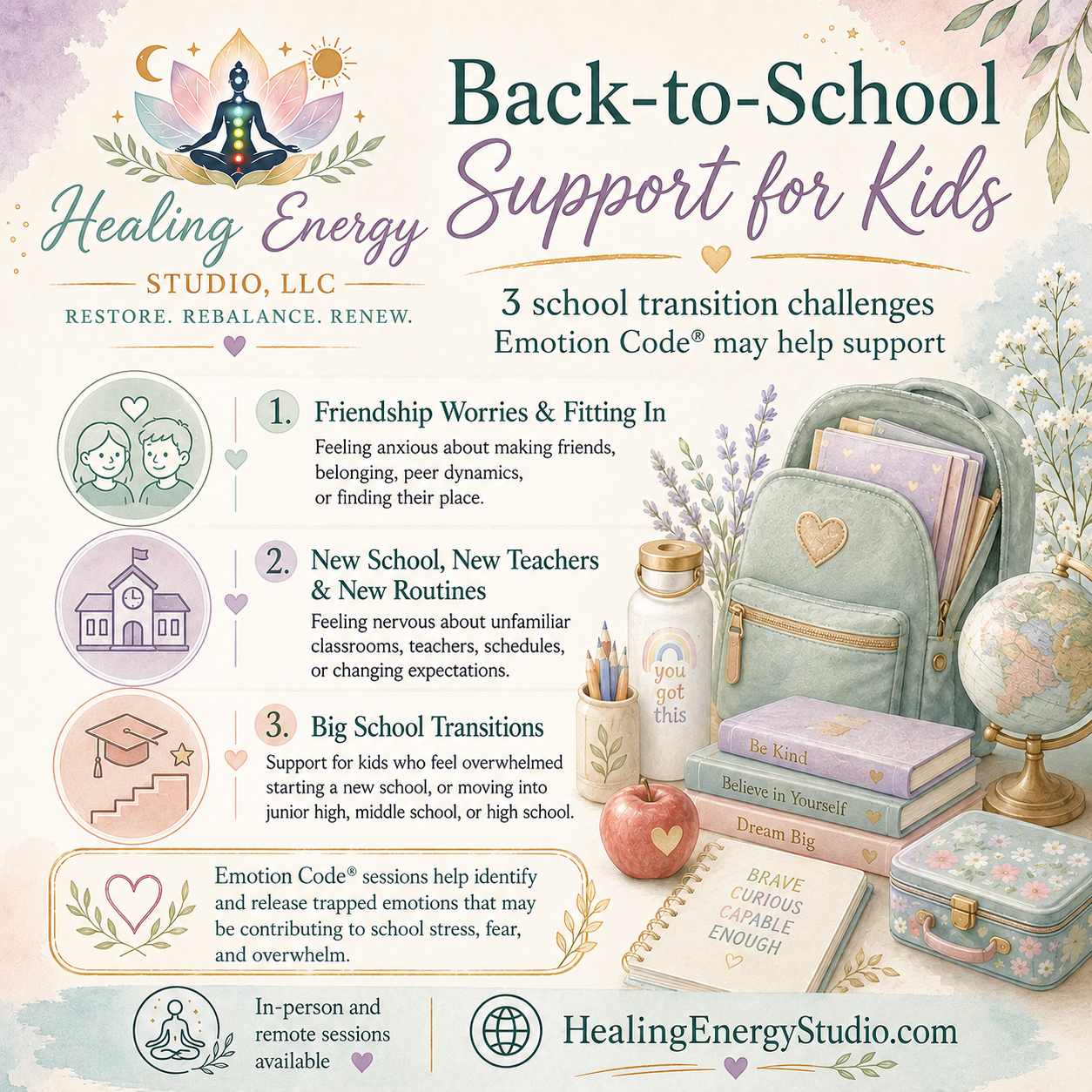
Back-to-School Anxiety: Gentle Support for Kids Facing Big Changes
Back-to-school stress may appear as tears, irritability, poor sleep, stomachaches, or “I don’t want to go.” Learn how parents can offer support and how Emotion Code may gently complement a child’s healing journey.
Back-to-school season can be exciting, but it can also bring up some very big feelings.
A child may be worried about making friends, fitting in, meeting a new teacher, finding their classrooms, handling a different routine, or moving into middle school, junior high, or high school. Even children who usually enjoy school may feel unsettled when so much changes at once.
As a parent, it can be difficult to know whether your child needs encouragement, more time to adjust, or additional support.
Back-to-School Stress Does Not Always Look Like Worry
Some children can clearly say, “I’m nervous about school.”
Others show their stress in less obvious ways. You may notice:
More tears or emotional outbursts
Irritability or arguing over small things
Trouble falling asleep or waking during the night
Headaches or stomachaches
Clinginess or difficulty separating
Changes in appetite
Avoiding conversations about school
Repeated questions about schedules, teachers, or classmates
Saying “I don’t want to go” without being able to explain why
Becoming unusually quiet, withdrawn, or overwhelmed
These reactions do not necessarily mean something is seriously wrong. They may be your child’s way of communicating that the transition feels bigger than they know how to express.
Three Common School-Transition Concerns
Friendship Worries and Fitting In
For many children and teens, the social side of school creates more anxiety than academics.
They may wonder:
Will my friends still be in my class?
Where will I sit at lunch?
What if no one talks to me?
What if I do not fit in?
What if friendships have changed?
These fears can be especially strong after a difficult friendship experience, a move, bullying, a long summer apart, or a transition into a larger school.
Your child may not need you to solve the whole situation. Sometimes the most helpful first step is letting them know their worry makes sense and that they do not have to hide it from you.
2. New Teachers, Classrooms, and Routines
New schedules and expectations can feel overwhelming, especially for children who rely on predictability.
A different teacher, classroom, bus route, lunch schedule, or morning routine may create more stress than adults realize. Even small unknowns can grow in a child’s mind when they do not yet know what to expect.
You can help by making the unfamiliar feel more manageable. Review the schedule together, visit the school when possible, practice the morning routine, or help your child make a short list of questions they want answered.
3. Moving Into a New School or Stage
Starting a new school or moving into middle school, junior high, or high school can bring several changes at once.
Children may worry about:
Getting lost
Changing classes
Using a locker
More homework
Increased independence
Older students
New social expectations
Whether they will be able to keep up
A child may feel excited and afraid at the same time. Both feelings can be true.
How Parents Can Offer Support at Home
You do not need to have the perfect response. Your calm presence matters more than finding the perfect words.
Try asking gentle, specific questions instead of simply asking, “Are you nervous?”
You might ask:
What part of school feels hardest to think about?
Is there anything you wish you knew before the first day?
Are you more worried about the schoolwork or the people?
What would help the morning feel easier?
Would you like me to listen, help you make a plan, or both?
It can also help to avoid immediately dismissing the fear with statements such as, “You will be fine,” even when you are trying to reassure them. A response such as, “I can understand why that feels like a lot,” helps your child feel heard before you move into problem-solving.
Other supportive steps may include:
Returning to a consistent bedtime before school begins
Preparing clothes and supplies the night before
Keeping the first week’s schedule as simple as possible
Building in quiet time after school
Encouraging movement, fresh air, and regular meals
Avoiding too many questions immediately after pickup
Giving your child time to decompress before talking
Where Emotion Code May Fit
Emotion Code® is a complementary energy-healing approach intended to identify and release trapped emotional energy that may be contributing to feelings of fear, stress, or overwhelm.
A session does not require a child to retell every difficult experience or explain emotions perfectly. This may be helpful for children who know something feels wrong but have trouble finding the words to describe it.
Back-to-school sessions may focus on emotional concerns connected with:
Fear of being rejected or left out
Nervousness about a new environment
Feeling overwhelmed by change
Lack of confidence
Previous difficult school experiences
Separation worries
Pressure to perform or succeed
Feeling unsafe, embarrassed, or uncertain
Emotion Code is not a replacement for medical care, counseling, school support, or mental-health treatment. It can be used as a complementary form of emotional and energetic support.
What a Session for a Minor Looks Like
Emotion Code sessions for children and teens require parental permission. Your consent form is filled out at the time of booking.
Sessions may be available in person or remotely, depending on the service selected. A parent may participate when appropriate, and the format can be adjusted to help the child feel comfortable.
For remote or email-based services, the child can continue with their normal routine while I complete the session remotely. Information and findings for a minor are provided to the parent or guardian.
This can be especially convenient for families managing school, work, activities, transportation, or children who do not want to join a live appointment.
Remote Support for Children—Wherever They Live
I have supported minors in different parts of the world through email-based sessions booked by their parents. These sessions allowed the children to continue with their normal routines while I completed the work remotely and provided the findings to the parent by email.
Parents have shared that the sessions felt supportive and helpful for their children, and the children themselves also experienced positive support from the process.
This option can be especially helpful for families who:
Live outside Idaho or outside the United States
Prefer not to schedule a live appointment
Have a child who is uncomfortable on camera
Need support that fits around school and family schedules
Want to receive detailed findings in writing
Prefer the parent to manage communication and follow-up
All sessions for minors require parental permission and are booked by a parent or guardian. Findings are provided to the parent or guardian when the client is a minor.
In-person, Zoom, and email-based sessions are available.
Learn more or book an Emotion Code® or Body Code™ session:
https://healingenergystudio.as.me/ECandBC
When More Support May Be Needed
Occasional nervousness around a new school year is common. However, additional professional support may be appropriate when anxiety is intense, continues to worsen, significantly disrupts sleep or eating, causes frequent physical symptoms, prevents school attendance, or interferes with daily life.
A pediatrician, licensed counselor, school psychologist, or other qualified professional can help evaluate ongoing concerns. Energy healing services can complement that support but should not replace it.
Your Child Does Not Have to Face the Transition Alone
Back-to-school stress is not a sign that your child is weak or unprepared.
It often means they care deeply about belonging, feeling safe, and knowing what to expect.
A little patience, reassurance, and support can make a meaningful difference. The goal is not to remove every uncomfortable feeling. It is to help your child feel supported while they move through the transition.
If your child is struggling with school-related fear, overwhelm, friendship concerns, or a major transition, personalized support is available through Healing Energy Studio.
In-person, Zoom, and email-based sessions are available.
Learn more or book an Emotion Code® or Body Code™ session:
https://healingenergystudio.as.me/ECandBC
Healing Energy Studio services are complementary wellness practices. They are not intended to diagnose, treat, cure, or replace medical or mental-health care.