

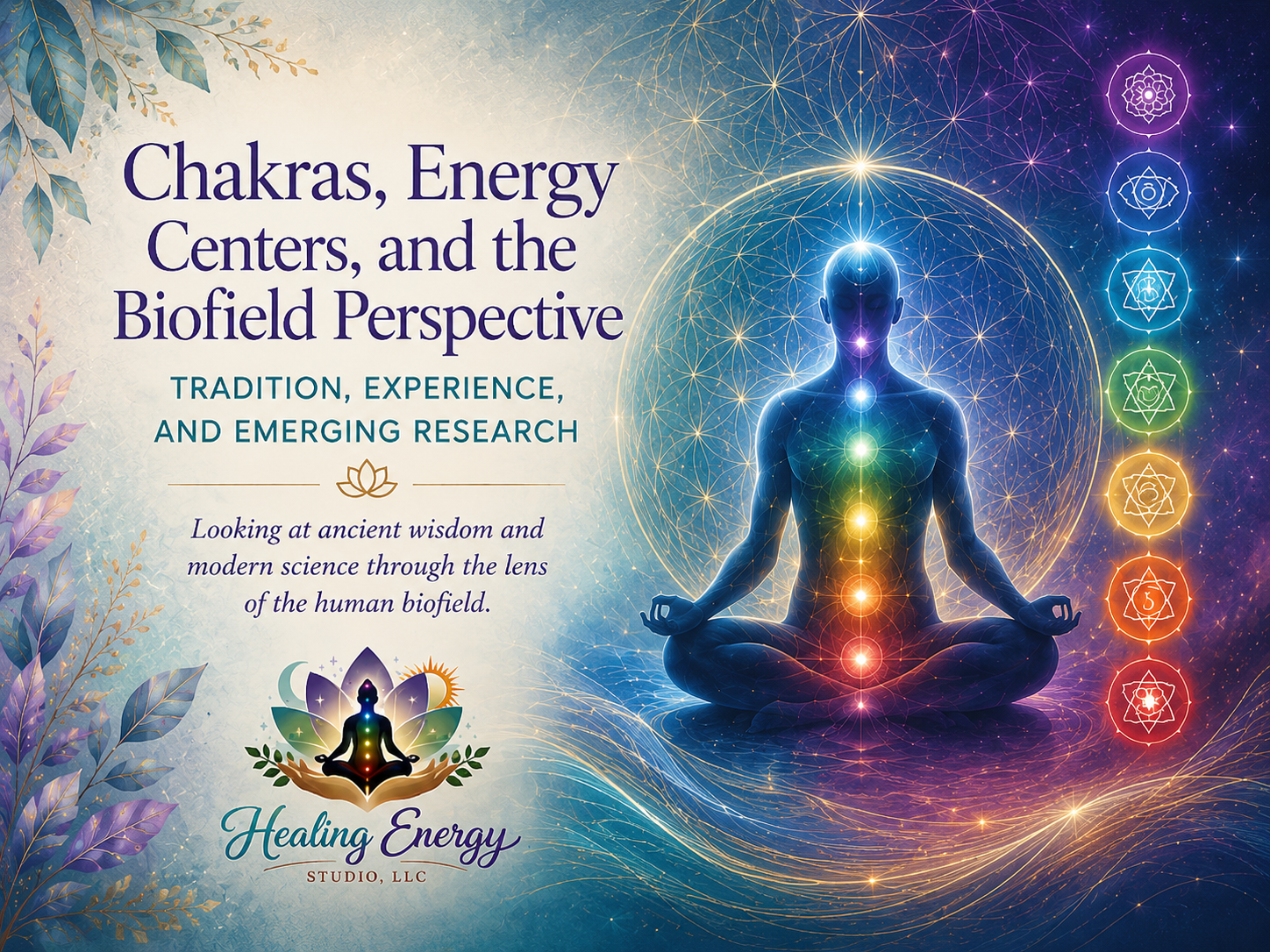
Chakras, Energy Centers, and the Biofield Perspective
Chakras come from ancient Indian spiritual traditions; the biofield is a modern research framework. They are not the same—but exploring both can open an interesting conversation about energy, experience, and the body.
Chakras are one of the most recognizable images in modern energy work: a series of centers running through the body, often shown in rainbow colors from root to crown.
But the history is much richer than that familiar diagram.
Chakras come from spiritual tradition
Chakra systems developed within Indian religious, philosophical, and yogic traditions. Different historical texts describe different numbers, meanings, symbols, and practices. The seven-chakra model common in Western wellness culture is one influential modern presentation—not the only chakra system that has ever existed.
Traditionally, chakras are part of a subtle-body framework rather than anatomical organs.
The biofield is a different concept
The modern term biofield is used in some scientific and integrative-health literature as a proposed framework for studying electromagnetic, biophotonic, and other spatially distributed aspects of living systems. One influential paper, Biofield Physiology, discusses measurable electrical and magnetic fields as well as more exploratory areas of research.
A biofield is not scientifically established as being the same thing as the chakra system. That distinction is important.
Why do people still find chakra language useful?
Because it gives people a map for paying attention.
The heart center can become a way to explore love, grief, boundaries, and connection. The throat can become a way to reflect on expression and truth. The root can become a way to think about safety, belonging, stability, and embodiment.
Whether someone understands those centers literally, symbolically, spiritually, or energetically, the framework can prompt meaningful self-observation.
Experience does not automatically equal anatomy
People may feel warmth, pressure, tingling, emotion, pulsing, openness, or heaviness in places commonly associated with chakras. Those experiences are real experiences.
What causes them may vary. Attention, breathing, muscle tension, autonomic shifts, expectation, emotion, sensory processing, and personal spiritual interpretation may all play roles.
Two maps can coexist without being identical
Modern anatomy gives us one map of the human body. The nervous system gives us another. Traditional energy systems give us another. Psychology gives us another.
None of them needs to erase the others.
I use chakra language as part of a broader energy-healing framework because it can help people notice patterns and connect with their own experience. I also think it is important to respect where those ideas came from and to avoid claiming that modern science has confirmed more than it actually has.
Sources for curious readers
Bridging Science and Spirituality: Two Ways of Knowing, One Human Experience
Science asks what we can measure. Spirituality asks questions of meaning, connection, and experience. We do not have to make one smaller in order to value the other.
I love science.
I also believe there are parts of human experience that we do not yet know how to measure.
Those statements do not feel contradictory to me.
Science gives us a disciplined way to ask questions
Science asks us to observe carefully, test explanations, compare results, and change our minds when evidence changes. That process has transformed medicine and our understanding of the body.
It is also still a process. Scientific knowledge expands because people continue asking questions—including questions that once seemed strange.
Spirituality asks different questions
Spirituality often asks about meaning, connection, purpose, inner knowing, love, consciousness, mystery, and our relationship to something larger than ourselves.
Those questions are not always suited to a laboratory instrument. That does not make them unimportant.
Where the two meet
The body offers fascinating meeting places. We know living systems use electrical signals, chemical communication, mechanical forces, and complex feedback loops. Researchers have even proposed biofield physiology as a framework for studying spatially distributed electromagnetic, biophotonic, and other field-like biological processes.
At the same time, traditions across cultures have described life in terms of energy, spirit, breath, qi, prana, and subtle anatomy.
Those are not automatically the same thing. But I think it is reasonable to place them beside one another and remain curious.
I do not need science to “approve” spirituality
Science is valuable because it helps us distinguish what can be demonstrated from what we hope, believe, or experience.
Spirituality is valuable because the most important parts of life are not always reducible to measurements: grief, love, awe, prayer, beauty, belonging, intuition, and meaning.
We get into trouble when we make scientific claims that evidence does not support. We also lose something when we pretend that only measurable experiences deserve our attention.
There is room for both
I can respect research and still leave room for mystery.
I can practice Reiki while acknowledging that science has not established its proposed energetic mechanism. I can be fascinated by bioelectricity without claiming that it proves chakras. I can value intuition while knowing intuition is not infallible.
For me, that is not indecision. It is curiosity with enough humility to admit that human beings are still learning.
Science asks us to keep looking. Spirituality reminds us that not everything meaningful waits for an explanation before it touches our lives.