

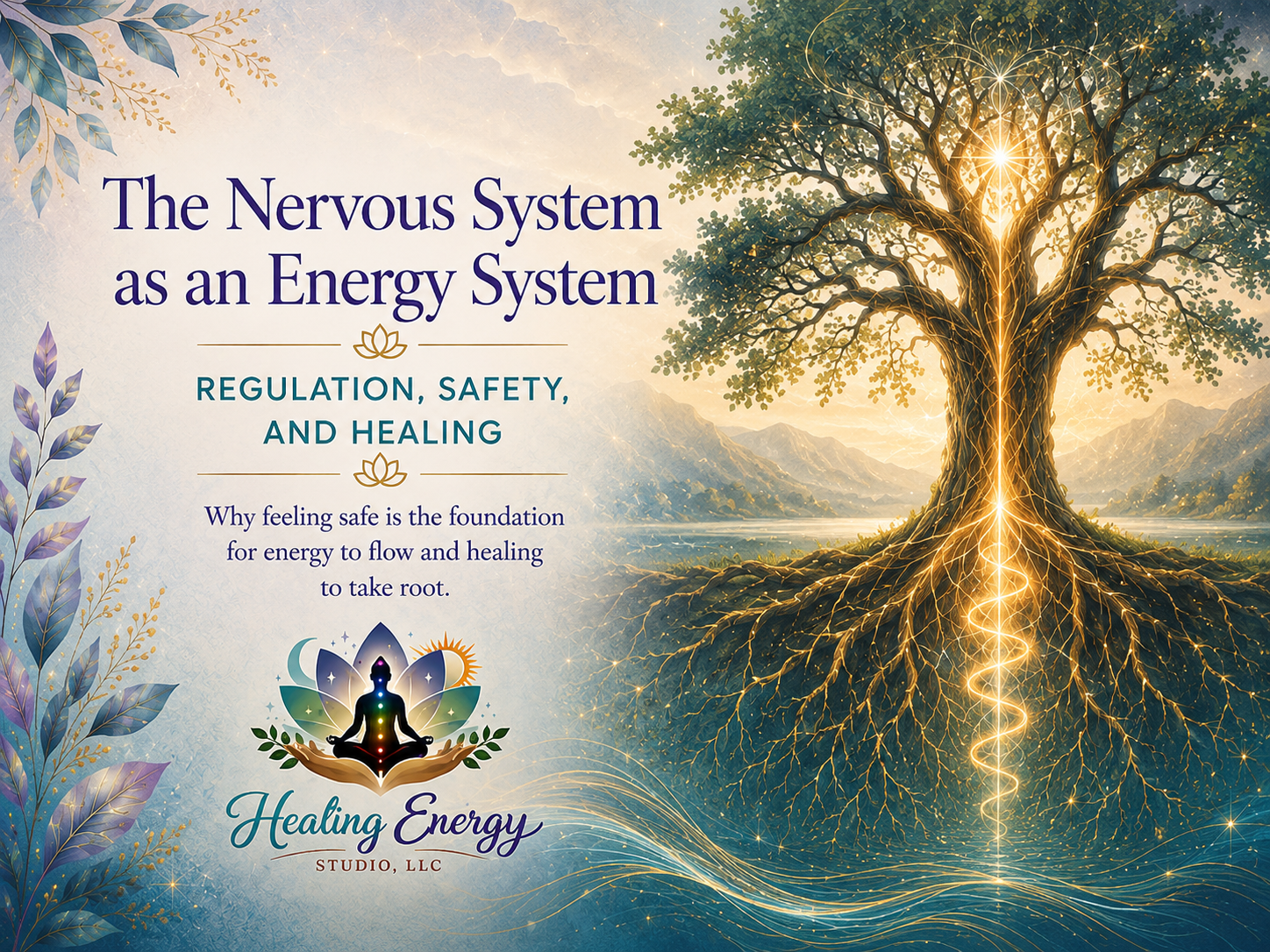
The Nervous System as an Energy System: Regulation, Safety, and Healing
Your nervous system communicates through electrical and chemical signals and constantly adjusts to the world around you. Explore why regulation and felt safety matter so much in healing work.
The nervous system is one of the clearest examples of energy and information moving through the body.
Neurons communicate through electrochemical signals. Nerves carry information between brain, spinal cord, organs, muscles, and sensory systems. Your autonomic nervous system continually adjusts heart rate, breathing, digestion, blood-vessel tone, and many other functions.
Your nervous system is always listening
It is monitoring both the outside world and your internal state. A sound, memory, facial expression, physical sensation, conflict, pain, or sense of connection can shift your state before you have consciously decided anything.
A major review of the stress response and the extended autonomic system describes the deep integration of autonomic, hormonal, immune, and brain systems in maintaining homeostasis and responding to stress.
Why safety matters
“Safety” does not mean pretending everything is okay. It means the body has enough signals of support that it does not have to devote every resource to defense.
This is one reason a quiet environment, grounded practitioner, predictable touch, permission, boundaries, and choice can matter during healing work.
Energy work can begin with regulation
I do not see nervous-system work and energy work as competitors. They can support one another.
Grounding, slow breathing, gentle attention to the body, and quiet Reiki can create conditions in which a person has a chance to soften. That does not prove a particular energetic mechanism. It simply recognizes something very practical: a regulated system has more room for awareness.
The body is electrical—but energy language is broader
The nervous system’s electrical activity is measurable science. When someone says, “My energy feels calmer,” they may be describing a larger subjective experience that includes nervous-system state, emotion, attention, meaning, and perhaps something they understand spiritually.
We do not have to force all of those layers into one explanation.
Sometimes healing starts not with doing more, but with helping the body realize it no longer has to fight the entire world at once.
Sources for curious readers
Energy and the Stress Response: What Happens When Your Body Stays on Alert
Stress is not just a thought—it is a whole-body response. Learn how the nervous system, hormones, breathing, tension, and energy can change when the body stays on alert.
Have you ever had a day when you technically did not do that much, but you ended it completely exhausted?
That is one of the clearest reminders that energy is not only about physical activity. Stress can consume enormous internal resources.
Stress is a whole-body event
When your brain perceives a challenge or threat, the body can activate a coordinated stress response. Heart rate and breathing may increase. Muscles may tense. Attention narrows. Stress hormones help mobilize energy for action.
The National Center for Complementary and Integrative Health describes stress as both a physical and emotional reaction and notes that chronic stress can contribute to or worsen a range of health problems.
A broad review of stress and health describes effects involving the autonomic nervous system, the HPA axis, cortisol dynamics, behavior, and gene expression.
Why stress can feel like an energy problem
When people say, “I feel drained,” “I feel wired,” “I cannot settle,” or “my energy feels scattered,” those words may be describing several layers at once: physiology, emotion, sleep, grief, uncertainty, and the energetic experience of feeling ungrounded or depleted.
Your body is built to respond—and to recover
The stress response itself is protective. The difficulty comes when the body repeatedly activates without enough opportunity to settle afterward.
Regulation does not mean never feeling stressed. It means having enough flexibility to move into activation when needed and then move back toward rest, digestion, connection, and recovery.
Why slowing down can change so much
Slow breathing, quiet attention, meditation, gentle movement, prayer, time in nature, Reiki, and other calming practices may feel very different from one another, but they often have one thing in common: they interrupt the constant demand for action.
For some people, the first noticeable change is physical—the jaw softens or breathing deepens. For others it is emotional. For others, the shift is described energetically: “I feel like I came back into my body.”
Energy work does not require ignoring the nervous system
In my work, I see the nervous system and energy as complementary ways of understanding the whole person. If someone is overwhelmed, grounding matters. Safety matters. Breath matters. Rest matters.
Healing is not always about pushing the body to do more. Sometimes it begins by giving the body enough space to stop bracing.